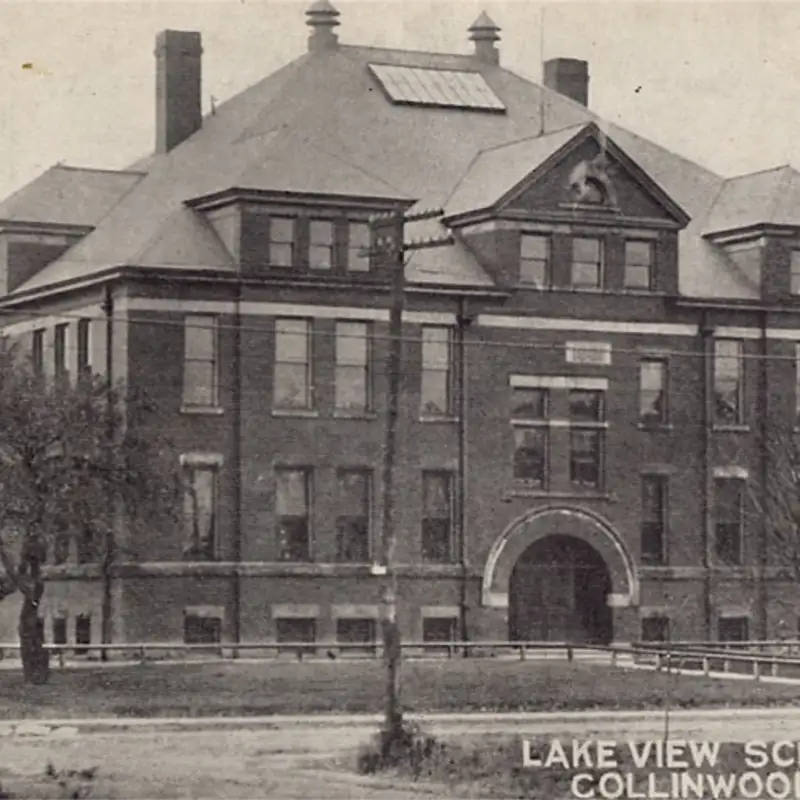
Lake View School, Collinwood Ohio, Part 1: Growing Village
In nineteen o eight, the village of Collinwood, Ohio was experiencing an enormous growth of population and industry. As railroad tycoons acquired and built on land that was once farms, village directors and real estate developers worked furiously to plan for a life around a constantly changing and expanding landscape. As part of this growth, schools were a necessity of the community. With a population that consisted mostly of Eastern European immigrants and their children, education was considered key to the future of the village. However, such rapid growth came with some very high costs.
Tim Coleman:On the morning of March '8, over 350 children would walk into the Lakeview School. 175 would never live to see the end of the day. Now, one hundred fifteen years later, Jeff Moss, Tyler j Thomas, and I, Tim Coleman, will tell this story and examine what was to blame for the senseless loss of life and how we prevent it from happening again today. This is The Three Tumblers.
Jeff Moss:The events we will be discussing occurred one hundred fifteen years ago. Many of the details have been lost to history.
Tyler J. Thomas:All attempts at accuracy have been made. However, official records are often incomplete and media reports of the day are somewhat unreliable.
Tim Coleman:A list of our source material will be provided in the episode description on our website, 3tumblers.com. In the mid to late eighteen hundreds, Collinwood, Ohio was a mostly agricultural community. Located just outside of Cleveland, there were lots of wide open spaces, fresh air, and a small community of locals. In 1877, however, the Lakeshore and Michigan Southern Railway began a massive expansion along its Lake Erie line. Cornelius Vanderbilt and the New York Central and Hudson River Railroad purchased a majority of stock in the line in order to provide an ideal line between New York and Chicago.
Tim Coleman:By 1898, the railway had constructed a yard in Collinwood that literally split the town in half. Local real estate companies planned to use large swaths of land for residential construction. Anticipating future growth, these investors planned lots for residential housing and commercial buildings alike. In addition to the railroad maintenance shops, there were other industries like Browning Engineering, Peerless Manufacturing, and the Linde Paint Company, all building facilities along tracks. Property developers had built scores of single family homes in anticipation of the coming population boom.
Tim Coleman:Most of these houses were 20 by 30 foot two story structures. Families moving to the area typically had between two and five children. Although living in a cramped 1,200 square foot home could be tough at times, they made it work on the hopes that the money coming in would lead to bigger, better things. However, there were certainly some drawbacks of the time. Rockefeller Creek, which ran through most of the village, was the primary outlet for sewage of the residents.
Tim Coleman:In nineteen o nine, an inspector from the Board of Health described the creek as a, quote, practically open sewer. More than 200,000 gallons of thick raw sewage from the town oozed into the creek every single day. Despite cramped housing and an unsanitary creek, Collinwood was attractive to many workers due to the numerous job opportunities and affordable housing. In fact, Collinwood experienced a growth of 85% between 1900 and nineteen o eight. Many of the workers moving to the area were immigrants from Eastern European countries.
Tim Coleman:After coming through Ellis Island and then going to New York City, Pennsylvania, and Boston, they most likely found job opportunities to be limited and housing costs expensive. With the rapid expansion of the village, planners and officials recognized the need for a school large enough to accommodate the influx of immigrants and their families. Collinwood's growth was closely tied to the development of the region. The presence of factories, railroads, and shipping facilities in the area, along with being a major transportation hub near Cleveland and having a harbor on the shores of Lake Erie made it an ideal destination of the time.
Jeff Moss:Tyler and Tim know this, but the listeners may not know that I live in Cleveland in one of the suburbs. So I'm sort of familiar with the Collinwood area, and it's an older, formerly industrial area. There's a lot of abandoned factories, warehouses, things like that. There's not a ton of industry there anymore. Doing some research for the show, I actually went there.
Jeff Moss:You'll see some pictures. And my dad and I drove around the area and there's a lot of places where stuff used to be and it's the the school is newer and there's some newer buildings in the area, but the actual part of Collinwood fairly abandoned. So if you could imagine what it was like a hundred years ago, it will sort of set the stage for how many people were in this building and sheer population growth of the area. It's not a very large area and it was its own village at one point, which was not for a very long time, but I would consider it a neighborhood of Cleveland at this point. Not really bustling anymore, but again, it used to be packed.
Tim Coleman:Yeah. I mean, the sights and smells from that time period just are were probably completely different than anything that we're used to. I mean, there's horses everywhere. There's a creek that's described as an open sewer. You have no air quality controls on any manufacturing plant.
Tim Coleman:So the atmosphere itself is is going to smell a lot different. It's going to just give off an entirely different vibe. You don't have any car horns, but you do have shouts from people trying to, you know, sell goods on the sidewalk. You have sounds from the manufacturing shops. Just researching this episode just kinda takes you back in time, and it's it's kinda cool to think about it in some ways.
Tyler J. Thomas:I have some firsthand experience growing up in a fast growing city like this. I grew up in McDonough, Georgia the late nineties, early two thousands, which was depending on the metric used, either the fastest growing city in America at the time or at least in the top five. And I was looking at the growth rates because that's just what they told us when we were in school. But year over year growth was between a 160 and a 190% in terms of population. So I remember nonstop traffic, constant construction, but most importantly, I guess most appropriately given this episode, I remember overcrowded schools.
Tyler J. Thomas:You know, it takes start to finish years to build a school. So when your year end growth is a 160, a 190% a year, that just exacerbates things because you're loading the existing schools beyond capacity year after year after year until the infrastructure can catch up. But fortunately, they didn't just cram us 50 into a classroom. They utilized trailers, classroom trailers. I can remember at some point in my freshman year, there were about 60 trailers on campus at this high school that would normally serve 2,000 kids.
Tyler J. Thomas:That's how overcrowded it was. And I remember almost all of my classes were in trailers. I rarely went inside the school. So, one day, you're AnyplaceUSA, and then before you know it, you're The PlaceUSA. So that's that's what happened to Collinwood.
Tim Coleman:In 1898, the cornerstone of the Lakeview School was laid. Completed three years later in nineteen o one, it reflected the Greek revival design which was popular at the time. A substantial two story brick building, it housed numerous classrooms, a full basement housing the mechanical components for heating, and a prominent front entrance. The building's design included large windows to allow natural light into the classrooms and to provide ventilation, which was essential in an era without air conditioning. With brick pier construction for the exterior walls and timber interior walls with wooden lathe and plaster, as well as wooden floors, the building was considered typical of the day.
Tim Coleman:The footprint of the school building was 66 feet by 84 feet. With two floors and a full basement, this gave Lakeview an area of approximately 15,000 square feet. In addition to being the primary source of education for the children of Collinwood, the Lakeview School also served as a central hub of the community, hosting events, gatherings, and meetings. In nineteen o six, with the constant growth of the population, including school aged children, and a push from concerned citizens, the decision was made to build a new high school and to also increase the size of Lakeview. New construction began in nineteen o six to add a third Floor to the school, increasing its volume to over 20,000 square feet.
Tim Coleman:Originally, the 3rd Floor addition was designed as a gymnasium, but was later converted to house fifth grade classrooms. The goal of the expansion was to effectively double the capacity of students. Most new schools built between the mid eighteen nineties and the nineteen o six Lakeview expansion used steel and stone for stairways and steel doors leading into them. Between the directors and partners at Searles, Hirsch and Gavin, the architectural firm hired for the project, the decision was made to continue the use of yellow pine and other wooden products throughout the new addition. There were also no new doors added to stairways or as exits from the building in general.
Tyler J. Thomas:So what they've done is they've increased the occupancy load, but they haven't increased the egress capacity. In other words, we're gonna allow for more people, but we're not gonna give them more capabilities to exit. And NFPA one, which is called the fire code, basically says that egress capacity has to be greater than or equal to the occupancy load. And both are calculated using mathematical formula, so it's not arbitrary and the same rules apply to everybody. But even if this was in place at the time, they've basically just thrown it to the wind.
Tyler J. Thomas:And kinda to understand why this happens, you have to view it from the mindset of the builders, I suppose. If the bones of the building can support additional structure on top, it's incredibly easy just to add to it. You're not changing anything else. You're just tacking on to what's already there. What isn't easy though is reconfiguring the entire building's interior below it, specifically the stairwells, exterior doors, all of that.
Tyler J. Thomas:That takes significant changes to the point that at that time, you might as well just ripped it all out and started from scratch. But that's not viable given the growth and the timelines. They need something quick, fast, and in a hurry, and life safety be damned.
Jeff Moss:Yeah. It obviously, with things that are just exploding, literally, they took shortcuts, and they probably didn't know any better back then, which seems to be a trend with our previous episode. Who would have thought that you should have a door open outward. You know, they didn't you don't know what you don't know, unfortunately. And and back then, I guess, they just didn't know.
Jeff Moss:And they would just hope nothing bad would happen that didn't work too well.
Tim Coleman:And as we're about to find out, a lot of that was due to money saving concerns. You see with a lot of small towns even today, they might have a decent sized tax base, but the town board members, village directors, whoever are in charge of the purse strings kinda cheap, and they don't want to spend a lot of that capital. During the eighteen nineties, proponents of reforming public education gained traction with the ideas of bettering the environment for learning within the public schools. In addition to changing from simply repeating spelling of certain words to learning the definitions and meanings behind them, the buildings themselves were to be more conducive to educating students. With a large number of immigrant children coming into the country, there was concern that they would not be able to adapt to their new home properly, much less become productive and educated members of society.
Tim Coleman:A number of architects consulted with psychologists and other experts of the time to design school buildings in such a way that there was natural light and fresh air in every classroom. Ventilation was important during the warmer months, and heating was even more important since the majority of the school year runs through colder weather. Proper sanitation and hygiene concerns were also addressed in order to prevent the spread of diseases. Now, by this point, you may be imagining the oldest school building you've ever been in. There are multiple long hallways lined with classrooms and lockers, offices up front at the main level, and an auditorium that seems way too small when compared to modern day schools.
Tim Coleman:Everywhere you turn, there seems to be a large window letting in the sunlight. These buildings were laid out in rough e or h shapes, designs that were inspired by palaces in Europe. So just think that if the oldest school building you have ever been in was built around the forties or fifties, that was a continuation of the reform style that began in the time period we are discussing. Something that I don't think I've ever shared with our listeners is the fact that I never attended public or private school at all growing up. I was homeschooled all twelve years.
Tim Coleman:But I did go to a number of events for four h or or other things that I was doing, and some of those were in older school buildings. And I remember one in particular. It was way up in Allegheny County. School building had been built probably in the thirties, maybe early forties. The the place just smelled like an old school building.
Tim Coleman:There's no other way to describe it. The paint probably still had lead in it. There was probably plenty of asbestos through the whole building, but I just kinda have that clear idea. And thinking back to Collinwood though, that was the modern at the time and not, not the old like we're used to now.
Jeff Moss:Yeah. And they're actually starting a project. The elementary schools that I went to were built in the late fifties, and they've been remodeled over the years, and now they're gonna be knocking them down and building new ones. Middle school that I went to is no longer there. It was built in the seventies.
Jeff Moss:It was a seventies nightmare. They knocked it down and built a new one about twenty years ago because it was all designed as an open floor plan, and then they put walls up later. It had just a lot of issues.
Tyler J. Thomas:It was
Jeff Moss:architects cluster. High school's been mostly remodeled too. So there's a mix, you know, when you go back to the elementary school to vote, you realize how much older these buildings are than and there are some older schools in some of the other suburbs. As far as I know, the outsides look old, but the insides are new. I don't personally go into a lot of them.
Jeff Moss:School districts that we service, most of their buildings are pretty new as well. So they're not building buildings, you know, most schools don't last for sixty years. It's almost like where you were in Collinwood and all that was one step above a one room schoolhouse, which I'm being a little bit over exaggerating a little bit, but not that far off. It doesn't seem like there was a ton of foresight.
Tyler J. Thomas:Jeff, do they still heat? Schools up there are using steam?
Jeff Moss:I'm pretty sure it's all boilers. I don't think it's actual steam. Not really sure. I guess it would be hot water heat, forced air, not a an HVAC. I would say that the buildings that we still have here that have those old boilers, I guess that would be still be steamy heat.
Jeff Moss:Radiator type things in each room. And I don't think new buildings are done that way, but the ones that still exist that have their boilers are still boiling.
Tyler J. Thomas:I remember watching movies and stuff in high school and as a kid, and I was flabbergasted anytime I saw a boiler room in a school because I I've never seen anything like that. We don't have it down here. There's a scene in Nightmare on Elm Street, where Freddie's chasing a girl in a boiler room at a high school, and I was like, where is this room in my school? So down here, and I guess, kinda what it sounds like they're doing up there now is we've always used heat pumps, but we don't have nearly harsh winters like they do up north.
Jeff Moss:So you're picturing the basement in Home Alone, and Kevin goes down there and the the big furnace is eating him.
Tyler J. Thomas:Yeah. Basically, we we we don't have that here either. I've never seen that. So it it you know, it's it's interesting to think about how they do it in different climates. Obviously, it gets a lot colder in Ohio than it does in Georgia or South Carolina, but it it does sound like dangerous equipment because I've worked at a hospital where we did have a steam plant to help with sterilization and stuff like that.
Tyler J. Thomas:And going in there and doesn't seem safe. I mean, I I know it's safe, but it certainly looks intimidating like Kevin found out Home Alone.
Jeff Moss:So speaking of steam plants, not to get completely off topic, but my college, all the buildings are connected together to a central steam. They actually built a new steam plant underneath the basketball arena. There's a giant rocket on the side of the building that emits white steam and it's it's pretty funny. But you would but it was not uncommon to have steam tunnel, you know, you would see steam coming out of the ground all the time, not necessarily from leaks, but just, you know, through the manholes and they're always working on stuff, but it was all the buildings were centrally you you had air handlers within the buildings, but the actual steam and hot water was, you know, centrally generated. There's a lot that goes into that.
Tim Coleman:If you're thinking that this is how the Lakeview School looked, you would be completely wrong. While the trend had been to have buildings laid out with multiple wings and hallways, Lakeview School was essentially built as a rectangular box. Although the nineteen o six expansion added a third story with steeply pitched gable roofs, underneath those roofs was essentially a box made of brick and wood. Students and staff approached the east entrance on Collamer Street into one of two main stairways. After walking through the doors, vestibules, and up the steps, they found themselves in a roughly oval shaped area on the 1st Floor.
Tim Coleman:To the right was the first grade classroom of miss Pearl Lynn, and to the back right was miss Ethel Rose's kindergarten class. To the rear left was the first grade classroom of miss Ruby Irwin. And finally, on the left front side of the 1st Floor was the third grade class of miss Grace Fisk. Between the two classrooms on the right were wardrobe areas where students not only hung their heavy winter coats, but could also keep their books and other school supplies. A teacher's room was located between the first and third grade classrooms.
Tim Coleman:On the far side of the middle landing area was another set of stairs. Both ran the entire height of the building from basement to third floor. They also both had entrances and exits for the building along with vestibules and wardrobes that were added during the nineteen o six expansion. The 2nd Floor was nearly identical to the first with the exception that the school library occupied the space that the teacher's room did on the 1st Floor. While there are no longer any existing diagrams of the 3rd Floor, it was constructed on top of the original building with plans to be a gymnasium.
Tim Coleman:However, with the constant growth of student population, it was soon converted to classrooms for the fifth grade students. Now, this may seem strange to most of you listening, but there were no restroom or toilet facilities on the 1st, 2nd, Or 3rd Floors. While the Lakeview School did have indoor plumbing, all of those facilities were located in the basement. Even more unheard of today, there was only separation of genders and not age. In addition to the restrooms, there were also rooms for coal storage, waste ash, and strangely, also playrooms.
Tim Coleman:The basement also housed two boilers in the center of the floor directly under the center oval shaped area just like the 1st And 2nd Floors. These coal fired units produced pressurized steam for heating. Pipes ran from the basement to a number of cast iron radiators located throughout the school to provide heat during the cold Midwest winters. While some reports say that these pipes were insulated with asbestos, there were certainly no fire breaks along them between the floors. The most dangerous heating element in my house, which was my school, was the propane infrared heater that we had in the downstairs hallway, and I learned that lesson a couple times getting too close to it by accident.
Tim Coleman:But it did keep the house warm during the, couple weeks of winter that we would have every year. But Collinwood, still you would think that with 350 kids inside, you know, even today they they still keep schools rather warm during the winter, like uncomfortably warm for me. And I love hot weather, warm air, but they still keep it really warm. But with that many people inside of a structure, you're still gonna get some body heat, but I guess it wasn't as well insulated back then either.
Tyler J. Thomas:Yeah. I'd be I'd be curious cause I know heat pumps had been around since the eighteenth century. I'd be wondering, you know, why they didn't have them here. Maybe it's because the winters were too cold to keep up. I know you said at the intro that there was snow on the ground at the time.
Tyler J. Thomas:Do you have an idea about how cold it was in terms of Fahrenheit on the day of the fire?
Tim Coleman:Yeah. The night before the fire, it got down to about 23 degrees Fahrenheit. And around the time of the fire, it had warmed up to a balmy 30 degrees.
Tyler J. Thomas:Okay. Yeah. That's exceptionally cold down here. I mean, the coldest it usually gets during winters is low thirties, sometimes high twenties. And then every once in a while, we get down into the teens or single digits, but that's exceptionally rare.
Tyler J. Thomas:So okay. Yeah. That might explain why they have what they have and when they had it.
Tim Coleman:The normal everyday comings and goings of staff and students were made through the school's stairways. The east stairway was considered to be the main entrance, likely due to facing the street where all the students walked up from. During the nineteen o six expansion, village directors opted not to install sidewalks around the building connecting the east and west entrances on the exterior. As discussed earlier, this was a cost saving measure. A sidewalk did exist from the street to the main east entrance, however.
Tim Coleman:As we mentioned earlier, vestibules were also constructed around the 1st Floor entrances. Designed as additional areas for children to hang their coats in, they rerouted anyone from using the stairs to have to make a 90 degree turn from the bottom of the stairs to then face and leave out through the main doors. There was also a fire escape on the north side of the building that covered from the 3rd Floor almost down to the ground, but not quite. At the end of the fire escape was a drop of about six to nine feet. Speaking of fire escape plans, fire drills were regularly practiced, with one occurring earlier in nineteen o eight.
Tim Coleman:During these drills, students were instructed and trained to follow one route of egress out the front doors. No drills included the fire escape and only some included using the west or back entrance. While there is no documentation that specifies what exactly was done during these drills, it is certainly not the orderly procedure that is carried out in schools all around the world today. If you've attended public or private school in the past forty years, you certainly have memories of these drills that were conducted nearly every month. Deafening alarms would scream through the halls, strobe lights flashed everywhere, and doors that were normally open suddenly closed.
Tim Coleman:You lined up in your classroom behind your teacher and followed them in single file down the hall, out the door, and to your designated rally point. There, you would silently stand in line while your teachers counted and checked that you and all of your classmates were accounted for. However, in the days of the Lakeview School in Collinwood, this sense of order and routine was not established. Whether this was due to inadequate training or negligence remains lost to history.
Tyler J. Thomas:Well, I wish I could say that this fire was the main driver of fire drills that we all did as kids in school, but it wasn't. If you want a school fire to point to for that it was the Catholic school in Chicago, Our Lady of Angels, in 1958 they had a massive fire. Not nearly, the amount of loss of life as as we're discussing here, but it was serious enough that everybody in the country pretty much got serious about conducting regular fire drills after that point. Naively as a kid I loved the fire drills because it meant thirty minutes outside of the class at least. I loved participating.
Tyler J. Thomas:We did it about once a month and sometimes they threw curveballs in there. You'd have a teacher standing in the hall saying, I'm the fire. So you'd have to redirect to another alternative point. So it got you into the mindset of thinking, if you encounter fire, know where your alternative exits are, which was pretty smart at the time. And then, Jeff, I guess you don't deal with this up there, but we also have what they called tornado drills.
Tyler J. Thomas:We basically had to get in the hallway and crouch down, cover our head.
Jeff Moss:Yeah. Of course, we had those, but you would walk through the school past the glass filled atrium to go to the basement. It was the stupidest thing. We had tornadoes here. We have we shouldn't never really had tornadoes, but we had drills every year and I don't I can really only remember fire drill maybe once or twice a year, certainly not every month.
Tyler J. Thomas:Yeah. We we had fire drills about once a month and then tornado drills leading up to what we typically call tornado season down here, is basically early spring.
Jeff Moss:Now on a completely different tangent, did you guys have to do a it would have everybody get in the school bus and practice jumping out of the back door. Do you ever do you have to do that?
Tyler J. Thomas:Yeah. Or the the side doors. You know how one of the windows busted out? Yeah. We did that as well.
Jeff Moss:Yeah. We always had and I was always afraid of breaking my ankle.
Tim Coleman:Well, know, again, my first school fire drill was when I was working as a school resource officer. And so I had to learn just, like, day one, like I was in kindergarten almost, how that fire drill went. I mean, I had been through them at, you know, other places like when I worked at the hospital. We had fire drills there. Nine one one, we didn't really have fire drills for the building, surprisingly enough.
Tim Coleman:But at home we practiced, you know, how do you get out? How do you open this window? Can you open this window? Do you go out the front door? Do you go out the back door?
Tim Coleman:And, you know, practicing and and having that thought process is good because, you know, kids like routine. And the more you do it, the better they get at it. And they know, you know, especially like you were saying, Tyler, if you can make them think on the fly, okay, if I can't get out this way, the way that I always go, which way do I need to go? And as we get farther into the story, we will hear how that could have really saved some lives. You know, critical thinking and practice makes perfect.
Jeff Moss:We had, the summer that I worked for the school's IT department doing computer setups and stuff like that, were they had hired a kid who a couple years older than me, to go around and update all the the evacuation, you know, the floor plans and evacuation maps over the summer for all the buildings, and they were in basically every room like you say. Last twenty, thirty years, it was always there and we just didn't notice it. Now, because it's what we do, like when I was on jury duty, I'm looking at these things all over the place, but they have to be correct. Also, you know, just having it, if something's changed, that could be a problem.
Tyler J. Thomas:I tell you another thing I remember too is that inside of every classroom I've ever been in, there was a evacuation plan right by the door printed out and laminated and taped up there. So it had a dashed line showing you the egress route to get out, but it usually had two. So you could go left, out of the classroom, or right depending on where the fire was. But that's another thing I remember, it was posted everywhere so you knew it.
Tim Coleman:Absolutely. And I think that regular practice is something that the more we talk about it, the more we will see where having those regular drills is a lifesaver. On Ash Wednesday nineteen o eight, it was cold in Collinwood, Ohio in the hours before the 08:00 school bell rang. The temperature the night before had been around 23 degrees Fahrenheit or negative five degrees centigrade with a light dusting of snow on the ground. 10 year old Caroline Kern and her twin brother, Rudolph, both walked to the school from their home at 6212 Arcade Street.
Tim Coleman:Their Austrian German immigrant parents had started the day as well, with their father going to work as a carpenter in a railroad shop. The nine year old daughter of the city building superintendent, Gretchen Dorn, was likely bundled up to keep off a chill on her way to the warm schoolhouse after being told, have a great day. I love you by her mother. 10 year old Thomas Thompson and his seven year old brother Niles, born to Swedish immigrant parents, walked together to school after saying their goodbyes to their mother before she went to work as a confectioner. Their father was deceased, so Thomas felt a great responsibility to help his mother and also look after his little brother.
Tim Coleman:At 08:30 that morning, Caroline, Rudolph, Gretchen, Thomas, and Niles, along with 345 other children, began that day with the regular school prayer. Within two hours, they would be speaking in person with the God they just prayed to.
Jeff Moss:Next time on The Three Tumblers.
Tyler J. Thomas:They didn't just keep the egress capacity the same, they actually decreased it.
Jeff Moss:It it's crazy to think of a door being two and a half feet wide.
Tim Coleman:Because within thirty seconds, the halls were flooded.
Tyler J. Thomas:As stated at the beginning of this episode, the producers of this podcast have endeavored to verify all facts as best as possible. However, official records of the events have been contradicted and otherwise obfuscated over time. We have made all attempts at presenting the most accurate account of events possible.
Jeff Moss:We would like to extend special gratitude to the creators of the website, collhamwoodfire.org, for their amazing work on curating the largest online multimedia archive on the history of the Lakeview school fire. We strongly encourage our listeners to visit collhamwoodfire.org.
Tim Coleman:Executive producer is Tyler j Thomas. Technical producer is Jeff Moss. Writer and editor is Tim Coleman. This has been a Three Tumblers production. Copyright 2023.
Tim Coleman:All rights reserved. Find this episode along with links to source material at 3tumblers.com and wherever you get your podcasts.