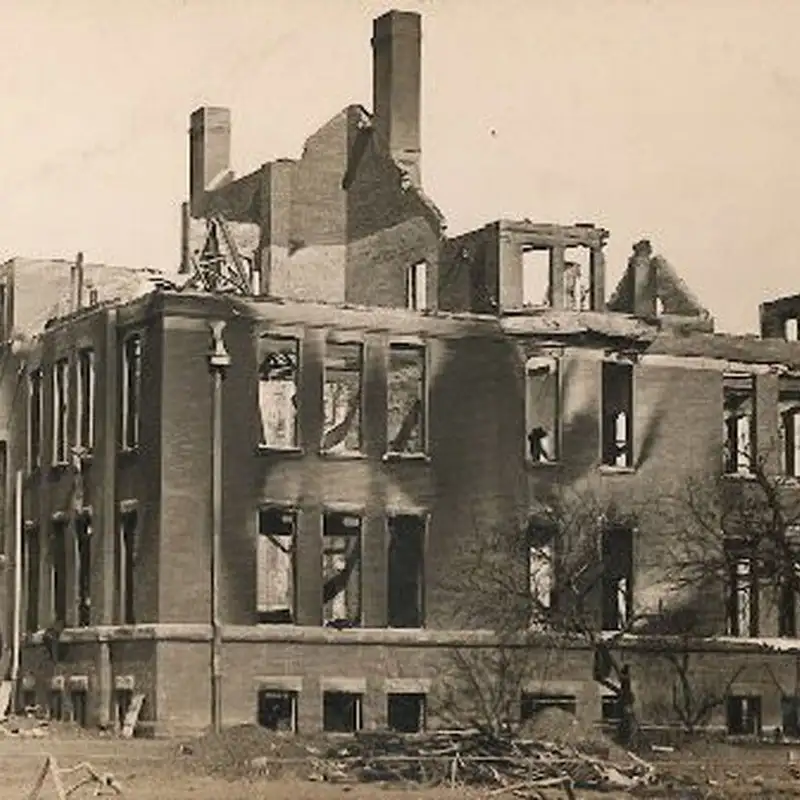
Lake View School, Collinwood Ohio, Part 4: A Village in Mourning
The acrid smell of smoke still hung in the air. It was late into the night of March 4, but survivors of the Lakeview school fire were being questioned. Fritz Herder, the janitor who rang the alarm bell and was severely burned in the blaze, was drawing a diagram in the dirt with a stick showing his observations of how the fire spread. He was just feet from the brick walls that contained the inferno. In the final part of our series on the Lakeview school fire, Tyler j Thomas, Jeff Moss, and I, Tim Coleman, will recount these investigations and how they helped change the future so that events like this one were prevented.
Tim Coleman:This is The Three Tumblers. This is part four of the Lakeview School fire series. If you have not yet listened to the previous parts, please stop this recording, go back and listen to them first. As mentioned before, all sources have been verified as best possible. However, we will link to all our source material on our website, 3tumblers.com.
Tim Coleman:Now, part four. The very afternoon of the fire, investigations began. Fire marshal Brogman interviewed the burnt and bandaged Fritz Herder on the grounds of the school. Fritz lost his eight year old Ida and 10 year old Walter and had witnessed his 13 year old daughter Helena burned to death inside the school. While there was some initial speculation that Hurter was somehow responsible for the blaze, this was quickly disputed and he was later hailed as a hero.
Tim Coleman:Official reports of the investigation have been lost to history. However, according to news reports of the time and the book, Complete Story of the Collinwood School Disaster and How Such Horrors Can Be Prevented by Marshall Everett, nineteen o eight. No official cause was ever determined. There was electrical wiring in the building, but that was ruled out. Also, the steam pipes leading from the boilers up through the school were reportedly wrapped in asbestos to insulate the wooden components of the structure from the intense heat.
Tim Coleman:However, there were many identifiable factors to the large loss of life that were immediately apparent. We have already mentioned and discussed the choke points at the bottom of the stairs. Having any kind of narrowing at a point of egress not only causes a delay in getting out, but it almost certainly guarantees an outcome as we have discussed in this series. Those who are trying to escape can and will trip and fall, and those behind them don't realize until it's too late and they fall on top of them. That decision to build the partitions proved to be fatal.
Tim Coleman:One fact that has been verified by multiple sources is that all of the exterior doors swung outwards. There were no doors leading outside that had to be pulled back into the building in order to open them. Also, the exterior doors were about 36 inches wide, which is the minimum standard width of any door sold or installed today in The United States. The stairs were also similar in width and comparable to today's standards. Also, the school's construction of brick walls and a completely timber interior made of white pine turned the structure into a charnel.
Tim Coleman:Since brick won't burn, but pine does, the walls acted as a chimney and fireplace. It kept the heat and flames concentrated inwards, and all of the fuel came from the wooden beams, floorboards, furniture, and anything else that could burn.
Jeff Moss:So, yeah, I mean, it seems like there's a like we've said before, it's just a perfect storm of bad construction, doors being too small, nothing good could have come of
Tim Coleman:that building it seems like.
Tyler J. Thomas:I've always worried about, especially doing access control, I'm only talking twelve, twenty four volts, 48 volts at max. What has to happen for an electrical arc to cause a fire with wood, specifically framing, building timber wood?
Jeff Moss:I mean, you would have to have, I don't know, you'd have to have like, a nail go across a hot wire in a ground that's attached to a wood stud or something. I mean, I don't really know what what could cause that. I'm not an electrician. I don't even play one on TV.
Tyler J. Thomas:Yeah. It's just curious that they would mention that as a possible source, but, obviously, it it's gotta be the pipes, the steam pipes. Wouldn't you think so, Tim?
Tim Coleman:Well, I mean, even in a lot of the documentation, it was it was noted in the documentation that the steam pipes were wrapped in asbestos. I mean, we've talked about asbestos before. It was the miracle fireproofing material of the time, and it still is pretty fireproof today. It's just a really bad carcinogen. That's why we don't use it anymore.
Tim Coleman:But, yeah, I mean, we see so many fires, you know, house fires, commercial fires, whatever, today that are all caused back to electrical causes. So, you know, I don't know if the wiring of the time was just so faulty, but like Jeff said, you would have to have a hut in the ground go across a conductor in some sort of material that was flammable. So even though the cause wasn't able to be determined, it might have been the pipes, but it also might have been electrical. I don't know. We simply don't have enough data to know what was found at the time.
Tyler J. Thomas:I I would say well, I'm in the camp that it was steam pipes because of how fast and how quickly and how hot it got within three minutes, like we talked about in the first part. I I just don't know if electrical can do that. And I don't I you know, we're we're working with what we know or what we've been able to find for this episode. Electrical may not have even been in the basement, so I don't know. But I'm in the camp that it was the steam pipe, and I've heard about similar situations.
Tyler J. Thomas:I used to work at the hospital with a locksmith that had one of these, not a steam pipe, but he had a furnace in his basement, and it got so hot because it was not it was insulated, but not entirely insulated. And when the firefighters got there and put everything out and inspected everything, he said, verbatim, that the timbers around it were glowing red. So I I'm in the camp of it was the steam pipes.
Tim Coleman:Well, and also too, there were no fire breaks between floors. So regardless of what actually ignited the fire, that fire once started in the basement could go floor to floor to floor without any interruption. It just traveled up the path of those steam pipes. Whether the steam pipes caused the fire or not, that was their sort of route to get through the building. Something else I'd I'd like to just say real quickly is that, you know, Fritz Herder, he was in the early hours after the fire, he was sort of a suspect as far as the cause of the fire, but he was later absolved of that and declared a hero.
Tim Coleman:And based on my reading, he really was a hero for not only for ringing the bell, but also trying to rescue children. And the reason why he was described as possibly a suspect at the time is PTSD was not a thing then. It existed, but nobody acknowledged it, nobody understood it, nobody recognized the signs of it. And having just watched your three children burned to death in a fire, that is going to make anyone change their answers.
Tyler J. Thomas:Yeah. To bring it home locally, that reminds me a lot of the Richard Jewell story with the Centennial Olympic Park bombing back in the Olympics in '96. They basically said the media said, you you had something to do with this. And he went through hell to do it. And ultimately, they figured out it was Eric Rudolph that did it.
Tyler J. Thomas:But, he was eventually hailed, rightfully so, as a hero. But initially, he was the villain, and then he became the hero. So, you know, I understand how people could be quick to judge looking for a villain so that they can alleviate some of their anger, misery, being upset. But even today, you know, 1996, we we still saw that. That that's just human nature.
Tim Coleman:As a result of the Lakeview school fire, many building codes regarding schools were immediately changed. No longer were there to be schools taller than three stories nor were they to have wooden interior structures. Fire escapes were ordered to be installed in existing schools in multiple states including Nebraska and Wisconsin. On March '8, the Omaha Daily Bee reported that building inspector Edward Coke ordered the 3rd Floors of 16 Milwaukee schools to be closed until fire escapes were installed in the buildings. Organizations such as the National Fire Protection Association and documents like the International Building Code reestablished to provide standards for existing buildings and new construction.
Tim Coleman:As part of these standards, egress capacity is determined by the number of occupants of a building floor. In other words, the more people you have in one place, the larger the exits have to be. The international building code also specifies that egress openings must be a minimum of 32 inches wide. There can also be no restriction between the bottom of the stairs used for egress and the doorway. In other words, what happened in Lakeview cannot happen anywhere else.
Tim Coleman:A sad fact about the school in Collinwood is that the stairs were 36 inches wide as well as the exterior doors. The narrowing point with the partitions for the additional coat storage brought students to a halt when their path of escape narrowed to just 28 inches. Most diagrams and documentation from the time show that this critical point was only five feet from the exterior doors, meaning that victims died literally within sight of safety.
Jeff Moss:28 inches is not a very wide door at all. Four feet, I mean, that's injurious at best.
Tyler J. Thomas:And I think the best part of it, if you wanna call it that, is that these kids did not die in vain. Their tragedy ultimately protected other children from experiencing the same thing, other parents seeing their kids die right in front of them or have to identify a burned body. These these kids, tragically as it may be, they died. But because of that, we learned, we got better as a country, and we said no more.
Tim Coleman:So I'd like to say, at first, going into this episode, researching it specifically for this section, I thought that maybe this was just a knee jerk reaction to say that, you know, schools could not be more than three stories high. But I think that has actually held true because every school that I've seen around here that is not college or university level has been either single or two story schools. And according to my research that I did for this episode, the tallest school in The US, the tallest school building in The US is in Chicago for the William Jones Preparatory School, and it is seven stories, but they only go up to twelfth grade. So with that being the tallest at seven stories, most metro major metropolitan fire departments have aerial ladders that can reach at least close to that, you know, probably get up to seven stories. And also with all of the modern day fire codes, William Jones, believe, was built in the early two thousands.
Tim Coleman:So there were a lot of good changes as a result of Lakeview. So it was not just a knee jerk reaction that we had here, it was a full blown nationwide realization. In nineteen o eight, there were no national organizations or government agencies to assist the families of children lost in the fire. However, the village of Collinwood set aside $25,000 to help with the funerals. Services lasted for days on end.
Tim Coleman:There were 175 bodies to bury. Churches, funeral homes, businesses, and individuals all donated to help not only with the costs of burials, but also to help the families financially. Many parents of deceased children were described as despondent or suicidal. Mental health was not a known term or practice at the time. However, members of the community did step up and help the grieving families.
Tim Coleman:Care and concern spread across the country with the news of the fire. Quote, the Collinwood School Children's Monument Commission, unquote, managed by the village council, worked through the postal service at the time to send for donations across the nation in order to erect a memorial in honor of those who lost their lives that day. Not long after the last funeral, the business and directors of Collinwood were getting back to the business as normal. As part of moving forward, directors initially saw fit to build a new school on the exact grounds of the Lakeview School. This caused an uproar amongst the citizens of Collinwood, including Robert Schull, a local contractor who lost his 11 year old son, Edward, in the fire.
Tim Coleman:Quote, if the board persists in building on the old site, the people of North Collinwood will call upon it with shotguns, end quote. After the public outcry and legal proceedings having been filed, the state of Ohio made the decision to settle the matter and purchase the land where Lakeview had stood. More than a year had passed after the Lakeview School and half of its students burned. Construction was started on the Collinwood Memorial School. With the new school's completion several years away, children attended school in temporary rooms that were considered to be completely unsanitary and unfit at the time by inspectors.
Tim Coleman:However, since a new school building was already under construction, these conditions were considered temporary.
Tyler J. Thomas:That reminds me a lot of after nine eleven, what they were considering to do on Ground 0. And there was talks of rebuilding on of it. And ultimately the decision was made, rightfully so I believe, to create a memorial and then build outside of it. So I understand the anger back then just as I did back in, well, after 2001, but, you know, that's ultimately the right call.
Tim Coleman:I mean, at what's happened in the last year and a half. Uvalde School in Texas after the shooting there. The town has planned already to demolish that building. Once everything is done with the legal process, that building is going to be torn down. And Parkland School in Florida, I mean I mean, I know we're going to talk about these in possibly future episodes, but we have these tragedies just like you were saying with 911 and the World Trade Center.
Tim Coleman:We don't rebuild on that. We tear those buildings down and we memorialize the incidents in an appropriate manner. And I think what the village directors of the time of Lakeview School in Collinwood, they were being very shortsighted. And it's so good to see citizens step up then, you know, almost a hundred twenty years ago, see them step up again and say, no. We don't want this.
Tim Coleman:And just the business as usual attitude, that was really way too soon. Yes. Life has to carry on. We all know that. The world does not stop because of one tragedy, unfortunately.
Tim Coleman:But at the same time, when you're dealing with such a small community of people, you do need to take the time to recognize that. And also, I would like to say that, you know, mental health at that time was basically non existent. And what we see from these stories as, you know, community members coming together to help each other, that was mental health treatment of the day. And there weren't really any therapists or people around to help the grieving parents. That was up to neighbors, friends, family members, clergy members, and just kinda all coming together.
Tim Coleman:So thank goodness we've changed so much in our support system since then.
Tyler J. Thomas:But I would still say that friends and family in a time of grieving are still the best way to navigate it. It may not be professional, but I tell you, when I'm feeling down or when I need help or something like that, nothing beats hearing it from a friend or family member pick me up, talk to me about it. You guys, we talk to each other, we talk about each other. Things we're going through in life, most of the time it's jovial, having fun, whatnot, but, you know, it's it's nice to talk to Tim, it's nice to talk to Jeff, you know, when we're going through stuff. And it's good to have that sort of support network, I guess I'm trying to say.
Tim Coleman:Absolutely. I agree with that 100%. Other than the people I work with, I talk with you guys literally every single day of the week. We have our group text that's been going on for a year and a half as of this recording, and you guys are friends. In 1911, construction on the Collinwood Memorial School was completed.
Tim Coleman:Built to the highest standards of fire resistance at the time, it featured no less than 12 readily accessible exterior doors for a building slightly larger than the Lakeview School. A stone engraving on the building read, schools and the means of education shall forever be encouraged. The school was demolished in June 2004. While not much is known of Emma Niebert's life after the fire, an obituary lists her death in January 1964 at age 72. Frederick Fritz Herder, the janitor who rang the alarm bell and heroically unlocked one of the exit doors during the fire, continued living even after losing his three children in the fire.
Tim Coleman:His wife Elizabeth passed away in 1943, fifteen years before Fritz died at the age of 95. Today, a memorial stands on the grounds of the Lakeview School. Jeff Moss recently visited the site, and we will share pictures that you can see on our website and social media channels. The village of Collinwood itself was the last victim of the fire. Unable to guarantee that it could sufficiently protect residents from fires, the citizens voted for annexation, and the village became part of the city of Cleveland in 1910.
Tim Coleman:Around the Lakeview School Fire Memorial Garden, the names of the victims are engraved on pavers, keeping their memories forever.
Tyler J. Thomas:Jeff, you were there. I mean, what does it feel like?
Jeff Moss:I mean, it's something that was a hundred and fifteen years ago. There's names which I'm assume there's some of the names are of companies that donated for the thing, but I'm assuming that the majority of the names on this memorial are of the students that and staff that passed away. I mean, it's a big you see it every day when you're there, I'm sure. And it's called, you know, they named the school Memorial School. It says right there, around the Lakefront School Fire Memorial Garden, the names of the victims are yeah.
Jeff Moss:So, I mean, it it I don't know that there's I'm sure there are descendants of people that are still alive that I don't think there's there couldn't be anybody that was there that's still alive. But, you know, it's important to remember what happened so it doesn't happen again. And that's I don't know how much they really explain, hey. This is why this thing is out there. You know, you don't necessarily wanna scare a bunch of young kids, but it's important for the community and everybody to know what happened a hundred and so years ago.
Jeff Moss:You know, there's no, like, big sculpture or anything. You know, like, they have a firefighter's memorial and it looks, big and painted with a firefighter out there. Know, it's basic.
Tyler J. Thomas:I tell you, never Tim and I never knew about this until you told us about it.
Jeff Moss:And it's not something we learned about in school. I I guess it's just known locally, you know, you know that it happened a long time ago.
Tim Coleman:Yeah. I mean, researching this episode just this is the hardest one yet that I've written anything with, but I am so glad. And I what I really, really hope is that people from our trade, our industry can take away from this is being able to convey historical information to modern day clients. No. No one's gonna be installing 28 inch doors now.
Tim Coleman:But when architects do something really stupid, which I've seen recently, then hopefully the locksmith can take history lessons from this and quote and say, Collinwood, Ohio, Lakeview School, nineteen o eight, this is what happened. This is why it happened. This is why I am not going to do this today until you get this fixed. That's my goal for this podcast, and I think it's everybody's goal for this podcast to give historical backing to locksmiths today so that they can make informed educational statements to their customers.
Tyler J. Thomas:Yeah. There's there's no amount of money worth the loss of a human life. So I I agree. I I think that locksmiths should add this to their arsenal to explain why they do what they do when they do. Iroquois, Collinwood, as we talk next, triangle shirtwaist, coconut grove nightclub, station nightclub fire.
Tyler J. Thomas:These are all examples, and they're all unique in the sense that they had one prevailing life safety default or one glaring omission that resulted in the massive loss of life. And we picked them on on purpose. We just didn't do it arbitrarily. Each one has their own example of why we should do something better. So I I agree.
Tyler J. Thomas:You listen to this, take note, take heed, and if a contractor, an architect, a customer, an end user, whoever kicks back, you should say, this is why we do what we do and why we do it. And if you have a problem, kick rocks, you know?
Guest 1:Boss, our design is perfected now. We're just a few weeks away from getting the patent. Aren't you sure? Hood doesn't have anything on us. Besides, our device is a thousand times better and more reliable.
Guest 2:Look, we've always managed to design whatever our customers want. But now is our time to build what the people need, whether they know they need it or not. I know for a fact that any one of is inches and minutes away from tragedy.
Guest 3:Gentlemen, I agree that this must be done now. We must fight for this, not to make money but to save lives. So I ask you, what must we do next?
Tyler J. Thomas:Executive producer is Tyler j Thomas. Technical producer is Jeff Moss. Writer and editor is Tim Coleman.
Jeff Moss:Find this episode and others along with our source material on our website 3tumblers.com or wherever you get your podcasts.
Tim Coleman:This has been a Three Tumblers production. Copyright 2023. All rights reserved.