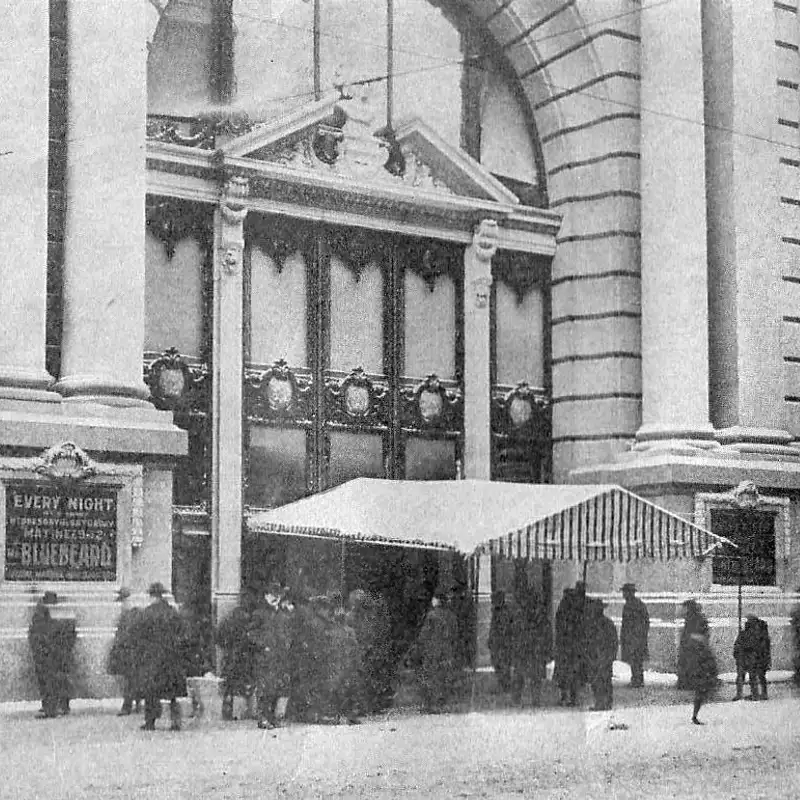
The Iroquois Theatre Fire, Part 1: The Theatre
In nineteen o three, the Iroquois Theatre in Chicago, Illinois was set to host a matinee performance of the musical, mister Bluebeard. The children's play starring Dan McAvoy and Eddie Foy featured physical comedy, actors dressed as animals, and ballerinas performing acrobatic stunts. Close to 2,000 people packed the seats, aisles, and every other space in which they could sit or stand in order to view the spectacle. Since the play was directed towards a younger audience, most of the people in attendance were women and children. This sellout event was well past the design number of around 1,600 attendees.
Tim Coleman:At 03:15PM, Wednesday, December 30, just over five weeks after the building's opening, tragedy would strike during the second act when a curtain on the stage ignited and burst into flames. Nearly 600 lives would be lost in the deadliest single building fire in the history of The United States. In this series of episodes, we will discuss what contributed to the massive loss of life, what lessons were learned, and how door hardware changed in an effort to prevent a repeat of this tragedy. Join Tyler J. Thomas, Jeff Moss, and I, Tim Coleman, as we take a look at this catastrophe and how it changed the locksmithing trade forever.
Tim Coleman:This is The Three Tumblers. The event that we will be discussing occurred over one hundred twenty years ago. Recordkeeping during that time period was sometimes shaky at best.
Jeff Moss:We have endeavored to base our program on facts that we can verify to a reasonable degree.
Tyler J. Thomas:That being said, there are still some accounts that vary wildly. In producing this show, have made every attempt to be as accurate as possible with records available today. We will post links to our source material in the show notes.
Tim Coleman:Part one, The Theatre. In 1893, 19 year old Benjamin Henry Marshall was fascinated by the construction of buildings for the Chicago World's Fair. Although his formal education ended in prep school, he managed to get an apprenticeship at an architectural firm from eighteen ninety three to eighteen ninety five. By 1902, Marshall had established his own practice. At only 29 years of age, Marshall became the architect of record for the construction of what would be known as the Iroquois Theatre.
Tim Coleman:Located inside the police patrolled Loop Of Chicago, it was hoped to attract more women as patrons due to safety from street crimes, as opposed to areas where patrols were less common. The main entrance to the theater was located at 24 West Randolph Street, a few blocks west of North Michigan Avenue. The backstage entrance was on Dearborn Street, while Stage Wright's scenery door was located on Couch Place. The construction of the theatre was commissioned and in part financed by the Theatrical Trust or The Syndicate. It was a sort of conglomerate who regulated stage productions at different venues across the country, but mainly New York and Chicago.
Tim Coleman:They regulated major plays much in the same way that national cinema chains do today. Furthermore, they were known to help finance the construction of new theaters, which may have attracted the two businessmen, Will J. Davis and Harry Powers, to collude on the project that would become the Iroquois Theatre. After purchasing the land where the theatre would be built, the business partners were eager to have construction completed as soon as possible. This may have been at the urging of the theatrical trust syndicate as they were starting to face competition from several outside upstarts.
Tim Coleman:Construction started in 1903, with an anticipated opening in October of that same year. The theater syndicate was facing some upstart competition at the time, and the board wanted the Iroquois construction project to be completed as quickly as possible. However, there were several labor disputes and some bad weather that pushed back the opening. Some delays, though, were taken care of through unscrupulous means. You know, today, it's very illegal to bribe public officials as far as inspections and code violations, but I think that we all know that happens still somewhat no matter where you go whether it's big towns or small towns.
Jeff Moss:I've heard stories over the years that back in the day here in Ohio specifically Youngstown that had a lot of mafia connections that it was just common knowledge that you would show up to your building inspection with a bottle of Jack Daniel's for the building inspector. I've also heard that envelopes would get left in certain locations throughout a building that needed to be inspected magically they'd be gone an hour later. I don't know that that happens anymore but it certainly did happen at one time.
Tyler J. Thomas:And then I guess the other thing to point out or to add some context, trust, you know, in the late nineteenth century, early twentieth century basically meant monopoly. So that's where antitrust, you know, anti monopoly, stuff like that comes from. And this wasn't like theory or conspiracy theory or hearsay or anything like that. They had their plan leaked to a paper, the St. Louis Post Dispatch in 1896.
Tyler J. Thomas:So everybody in the world knew what they were trying to do. Of course, they denied it and gave an interview where they denied it, but their plan was leaked. So there's no ifs, ands or buts about what they were trying to do.
Tim Coleman:One of the main focal points in the public foyer were a pair of grand staircases. These stairs were open to viewing by all in the main foyer, encouraging a sense of see and be seen, regardless of your seat and by extension, the price you paid for your ticket. With 53 foot high ceilings, this was certainly a grand entrance bound to make even the poorest attendees feel a level of pomp and sophistication. Throughout the foyer, halls, and audience seating, lush carpet covered the floors. Elegant draperies lined the walls and balcony fronts, and was accented with ornate wood trim throughout the entire building.
Tim Coleman:Walter K. Hill wrote in the New York Clipper, a predecessor of Variety Magazine, that the building was, quote, the most beautiful in Chicago and, quote, few theaters in America can rival its perfection. You know, you think back to times like that, and we really don't see a lot of design elements like that in modern buildings. Everything's sleek and metal and glass, but you can still get a sense of places like that that were built during the time and with the thought of opulence. When you visit some of the old buildings in, you know, the more established cities like Chicago, New York, or even down here in the South, if you've ever visited the Biltmore Estate, You know, huge hallways, wood paneling, very high ceilings, draperies, carpets, very, very fancy.
Tim Coleman:We really don't see a lot of that today.
Tyler J. Thomas:A lot of combustible materials as we're soon going to find out.
Jeff Moss:Yeah. And here in Cleveland, there's a lot of older theaters, older buildings, but they've all they maintain their opulence, but they've been properly updated and kept in accordance with the codes. If you look up a place like Severance Hall and Cleveland Playhouse theaters that are Playhouse Square rather they're old but have to follow rules. There may be exemptions on some things but there's still always a way out. It's not like what you'll hear today.
Jeff Moss:New theater is certainly not going to be as fancy.
Tim Coleman:A somewhat unique design element of the Iroquois Theatre was that the main auditorium was situated perpendicular to the main foyer. Showgoers entered from the stage left side of the main theatre area, instead of from the back of the auditorium, which is custom in modern theatres. This was due to an existing seven story building located on the corner of Randolph And Dearborn Streets, a building which still stands to this very day. Theatregoers who could afford orchestra or parquet level seatings paid premium price. These seats would provide eye level viewing to those in attendance.
Tim Coleman:They were the equivalent to the modern day first class or premium seating at any event. Also, since electric sound amplification was decades away, the audience in this level could hear the actors' dialogue more clearly than those in the upper sections. However, the Iroquois Theatre touted that every seat in the house was the best seat. For productions such as Mr Bluebeard, which featured acrobatics over parts of the audience, seating had been designed to give everyone a nearly perfect view of the action. The orchestra level provided seating for seven forty four.
Tim Coleman:Above the orchestra level was the balcony, or dress circle, with four sixty five seats. And finally, the gallery, holding a total of four seventy five seats in the topmost seating area. During construction, Benjamin Marshall was unable to produce scale drawings of the building plans to city inspectors, so accurate dimensions are difficult to come by today. When the Iroquois Theatre received its fire rating and period equivalent to a certificate of occupancy, it was rated for sixteen oh two people in attendance. This number, similar to ratings today, did not include theatre staff or cast and crew of the production.
Tim Coleman:Now, we've broken down the dimensions and actual space of the theatre to give you a better sense of the venue. From the back of the seating area to the front of the stage was 69 feet, and side to side was between eighty three and eighty five feet. Taking additional dimensions in account, the orchestra level was approximately 5,800 square feet. The balcony and gallery were both approximately 2,800 square feet. For comparison, an average modern day movie cinema is approximately 2,900 sq feet, with seats for about 200 people.
Tim Coleman:This gives each person around 14 square feet of space within the enclosure. In the Iroquois Theatre, however, patrons at the orchestra level got about eight square feet per person. Balcony goers had approximately 6.5 square feet, and the gallery attendees only had 5.5 square feet per person within the enclosure. None of this included ticket holders who were in the standing room only areas. Places in the aisles, back, and sides of each section.
Tim Coleman:Also not included in the count were the cast of between three and four hundred actors.
Jeff Moss:I've done a lot of theater work over the years mostly backstage but you in much larger places you have multiple ushers, you have house manager whose job is to make sure that everything in house which is where the people sit is okay and safe and all that. My mom used to usher at the Playhouse Square here and at one point they would allow the ushers to sit in the aisles and then they changed that. Everybody's got to be in a seat and I don't know that it's fire code related but it certainly is a good idea that everybody's in a seat unless they don't need to be having exits clearly marked, having a clear path of egress, lighting on the floor or at the aisles and things like that. Back then they didn't know, they didn't care. That's all these things contribute to what we're hearing about today.
Tim Coleman:I've never been in a location where they allowed people to pack the aisles, so to speak, like they used to. Personally, I don't like crowds. I don't like big crowded buildings, Just not necessarily from the point of view we're looking at them today, but I just like some space. That's why I like to go to a matinee during the week. Instead, there's not as many people.
Tim Coleman:They the the if if
Tyler J. Thomas:you go to any concert, sporting event, whatever, anything that doesn't have general admission, if there's assigned seating, they will not let you sit, stand amble around too long in an aisle or at the start of a section. They're over there trying to get you to your seat because you know you don't want people in the path of egress I assume or the exit plan. The only difference is hockey when it's in, you know, pucks in play and they don't want somebody walking down the the stairs and getting hit with a puck. But that's the only exception I can think of. I I really hate this layout as you were describing it, Tim.
Tyler J. Thomas:It's just if you think about it, anybody listening, think about being in a movie theater or a playhouse or any sort of, you know, theater. Imagine you're sitting in the middle lower floor to get out. You're probably gonna have to turn around, walk up the aisle and your exits are gonna be behind you. Here it's different. Imagine to your left are the exits.
Tyler J. Thomas:That's the way you can get out to the to the lobby. So that means you can't necessarily walk back through the aisles and then out. You've either got to go to the very front of the gallery and walk out to your left, the very back of the gallery go out to your left, or you have to cross through the seating areas which if you've been to a modern one you know you have to kind of side shuffle to get through it. But as Tim describes with the square footage and the number of people that they've packed in there, I have to imagine that those aisles were even more narrow than they are now. So it's just it's not conducive to a efficient, expedient path of egress.
Tim Coleman:The Iroquois Theatre had been running successfully since its opening, showing only one production. Mister Bluebeard was a traditional three act play with scenes taking place in exotic locations such as Baghdad, yachts, the Isle Of Ferns, castles, secret chambers, palaces, and even the old woman who lived in a shoe. The play was tremendously complex in terms of scenery and the numbers of actors and stage crew to bring the story alive. Numerous painted canvases, props, and other movable scenery lined the backstage area. The Iroquois Theatre had been designed for such large productions, having a substage nearly 20 feet deep and infrastructure going vertically nearly 80 feet to the Second Fly gallery.
Tim Coleman:Now it's important that we take a break right now just for a second to discuss the actual play itself. Mister Bluebeard was marketed as a children's play, but the actual story dates back to a French tale from the sixteen hundreds about a rich man who murders his wives and then hangs them in chambers of curiosity throughout his castle. So think of it kind of like a modern day silence of the lambs musical for kids. I mean, how wonderful is that? A lot of
Tyler J. Thomas:the Disney original Disney movies, not the the modern stuff, but Hunchback Notre Dame. Anyways, Han Christians Anderson stuff, a lot of them have very not children friendly themes and details, but they still became children's movies and books and stuff like that. So it doesn't surprise me, but this is definitely one of the more morose ones I've heard about marketed to kids.
Tim Coleman:Well, and also think back to Halloween costumes of the time. You look at pictures from back then and people dressed up as the Easter bunny even or scarecrows. And to look at those costumes now might give you nightmares. I mean, just depending on who you are and your sensitivity towards that stuff. So people were definitely different from what we are now.
Tim Coleman:Chicago has been and still is known as a city of extreme weather temperatures. Being next to Lake Michigan, winters can be bitterly cold and snowy. On December '3, the day of the fire, the official recorded high temperature was 15 degrees Fahrenheit or negative 9.4 degrees Celsius. You might think that with over 2,000 people plus electrical equipment and hot lights all going, it would get uncomfortably warm really quickly inside. However, with the extreme cold outside and possibly due to shortcuts during construction, the air circulation vents were closed and sealed shut.
Tim Coleman:These vents were also designed as part of the fire suppression system. As we will discuss later in the series, this resulted in catastrophic consequences. While it is hard to believe today, fires in theaters were fairly common in the late eighteen hundreds and early nineteen hundreds. When the Iroquois Theatre first opened in November '3, it was touted as being, quote, absolutely fireproof.
Tyler J. Thomas:It's never a good idea especially in business to speak in absolutes because that paints you into an absolute corner. If you say something as bold as this lock can't be picked for example and then they go on YouTube and they see it picked well you look like an idiot. I think a better way to describe it is resistant. Fire resistant. Pick resistant but never pick proof.
Jeff Moss:Yeah I mean we've I've always said that if somebody makes it somebody else can defeat it no matter what it is. Not always gonna take five seconds but it can be done with enough time, skill, tools so saying that place is fireproof it's statistically impossible. Back then you could probably claim a lot of things that now you'd have a team of lawyers telling you I wouldn't do that if I were you.
Tim Coleman:You would think that nine years later when the Titanic sunk they might have learned their lesson about describing things in absolute, when they said that that was the ship that was unsinkable. I guess that's why, to Jeff's point, we have teams of lawyers today. Throughout the nineteenth century, the city of Chicago was rife with fires. The Great Chicago Fire of eighteen seventy one and several others that followed, along with frustrated insurers, put pressure on city officials to prevent future catastrophes. The solution was simple, albeit woefully inadequate.
Tim Coleman:No new construction could be made out of all wood. Rather, all new buildings were required to be built with stone walls. Now, let's take a minute to relive eighth grade chemistry class. It takes three components to sustain fire: heat, fuel, and oxygen. This is known as the fire triangle.
Tim Coleman:If you take away only one side of this triangle, the fire ceases to exist. Wood is certainly a great fuel to fire. After all, who hasn't built or been around at least one campfire in their life? By taking away wood sided construction in the city, it would be much more difficult for fire to spread from building to building. Officials knew the fires would inevitably happen.
Tim Coleman:However, the goal was to contain it to one building. Even with these building material codes though, none covered provisions for what materials could be stored inside or how occupants of the building had to be able to exit. Today, we have clearly marked exits. In movie theaters, we have the little announcement before the start of the show pointing you towards the exits of the building from the house area of the theater. But also, we should have or at least I do whenever I go into any building I'm mentally, subconsciously building a plan to exit.
Tim Coleman:Which door did I come out of? Are there emergency exits nearby? Are they well lit? Is it what's closest to me? Is it what flows naturally?
Tim Coleman:In addition to getting out of buildings as a locksmith or anybody in the service industry really who is making house calls, you should also have plans to escape from, those locations as well. So being able to exit in the case of some sort of emergency and being able to exit quickly could make the difference between, being okay and not being okay. If things don't look up to par, look kind
Tyler J. Thomas:of shady, kind of feel like you're in a trap, if something were to happen, it's okay to walk away. There's a
Jeff Moss:Yeah. I mean, it's sad that you have to do that, but it's a reality today. You know, if you're in a house of worship or a school or anything like that you always got to be aware of your exits you know just like they say on the airplane make sure that you know the exit in front of you behind you.
Tyler J. Thomas:That's another function of the people the ushers and all of that. Yeah they're checking your seats and all of that but the reason why a lot of us aren't briefed when we go to like these sporting events and I can only ever recall it once at a falcons game, an NFL game, you're not briefed on exit routes, emergency plans, all of that. Their function one of their functions is, if something were to go wrong, to get you out of that section into to a safer place.
Tim Coleman:Active fire suppression was common in many forms for years prior to the Iroquois fire. By 1903, there were over 200,000 building sprinkler systems installed across The United States. Sprinkler systems are actually quite simple. You have a pipe, or a line of pressurized water, with openings spaced 12 to 15 feet apart. These openings are blocked by plugs held in place by a piece of glass or other material that is specifically engineered to melt and give away at a certain temperature.
Tim Coleman:In contrary to what movies and television would have you think, only one sprinkler head activates at a time. Standpipes are another fire suppression system that were common in the late eighteen hundred's and are still in use today. In a basic sense, standpipes are a direct way for fire departments to have pressurized water to all areas of a building. When you go to your local supermarket, you may see a sign on the outside of the building that says FDC or Fire Department Connection. In the event of a fire, the fire department arrives and connects their pumper trucks to a water supply or a hydrant and also to the FDC.
Tim Coleman:The pumper then pumps pressurized water through the standpipe system throughout the entire building, firefighters to have high pressure, high volume water flow in the areas on fire. This technology had been around for several decades by 1903 and was standard practice during construction. However, the Iroquois Theatre's standpipes were not connected to any water source nor were they accessible to the fire department. This may have been attributed to the haste at which the building was constructed. Also surprisingly common both then and now were portable fire extinguishers.
Tim Coleman:Modern fire extinguishers were commonplace by 1903, having been invented almost one hundred years prior. While not as lightweight and portable as today's extinguishers, they shared the same basic design and concept. In essence, you have a pressurized container with a chemical mixture or just plain water along with a valve, hose and nozzle. In the event of a fire, you pull the safety pin, aim the nozzle at the base of the flames, squeeze the release mechanism and sweep back and forth dispersing the chemical mixture on the fire. This would remove either the heat, oxygen, both or all components of the fire thus extinguishing it.
Tim Coleman:Instead of fire extinguishers, the Iroquois Theatre had devices known as kill fire. Kill fire was a chemical concoction based mainly on bicarbonate of soda when directed onto the fire, would in theory cut off oxygen to that fire. Operating instructions on kill fire devices included directions such as throw contents with great force at the fire, although no instructions had been provided to staff or performers at the Iroquois fire. After the disaster, the devices were tested and found to be about as effective as table salt. Something that may or may not be coincidental is that Chicago Alderman John E.
Tim Coleman:Scully had a side business that was involved in selling Kill Fire. Another feature that was specifically designated in the original plans was a fire curtain on the stage itself. The stage featured a grand archway, such as had not been seen in any other theatres to that point. A grand curtain, made mostly of asbestos and painted with beautiful imagery, was to hang from a weighted system in the upper area of the arch on stage. But instead of being just another decoration, it was connected to a quick release system of sorts in the event of a fire.
Tim Coleman:This system had a series of triggers, both automatic and manual, coupled with counterweights to drop the curtain in the event of a fire. Although today the health effects of asbestos are well known and documented, it was widely regarded at the time as a miracle fireproof material. However, the curtain in the Iroquois Theatre was not a true asbestos curtain. Instead,
Jeff Moss:it
Tim Coleman:was made of a small concentration of asbestos and then filled with wood pulp, cotton fibers, and other materials. Whether this was done as a money saving measure or simply an oversight will forever remain unknown. I mean, guys, let's face it. How many times have we seen buildings where the contractor is cheaped out?
Tyler J. Thomas:Lots. Yeah. All the time.
Jeff Moss:They call it value engineering.
Tim Coleman:And also, want to say something about the kill fire sticks. The way that these were designed to be used, that I found out through research for this episode was basically it's a a cardboard tube that looks something similar to a road flare. I couldn't find an exact size on it, but I think it's, probably closer to the size of a wrapping paper tube that we all use to sword fight with as kids. It was packed full of this fire retardant chemical in there. The way that you got it out was you literally had to swing it like a baseball bat almost in order to expel the powder from the end of it.
Tim Coleman:And that just does not seem like a good idea as far as simple operation, especially when you're panicked.
Jeff Moss:Yeah. I mean, nowadays we take for granted, fire prevention, protection, detection systems, as well as suppression. You can see behind me, have some fire alarm stuff on the wall. Actual correctly installed building, it's all monitored. There's trouble conditions, supervisory conditions, actual alarms.
Jeff Moss:It's all being monitored by a central station. You have people in the building that generally know what to do when something goes off. You know, they're required to be tested annually, sometimes biannually, depending on what it is. They didn't have any of that. Back then.
Jeff Moss:Nowadays you stand a much better chance of knowing that there's a problem. There was a big fire at a synagogue here that I used to go to and the fire alarm didn't go off but luckily somebody saw it, heard it, smelled it. It was electrical fire on the roof that caused quite a bit of damage. You have duct detectors, smoke detectors. This fire actually started outside, so that's probably why the alarm didn't go off because it was on the roof.
Jeff Moss:All these things that they didn't have back then or if they did have anything close they were very inadequate not used properly.
Tyler J. Thomas:They still use throwable extinguishers. Have you all seen any of them? Like, you know, they've got that ball now where you throw it at the base of the fire where the fire is and it melts through that fusible container and just douses it with chemicals and water and all that. Have y'all seen those?
Tim Coleman:Yeah. I've seen something about it. I've never used one or seen one in action, like in a training fire, but it just still seems like a really bad idea because for somebody who can't throw a baseball to save his life, I would totally just be in trouble if that was my only means of extinguishing a fire.
Tyler J. Thomas:Yeah. I mean, there's two things. They they do say that it's not it it shouldn't be the only option. It's it's supplement your fire suppression capabilities, whether it's sprinklers or extinguishers. But the other thing too is they're kind of like halfway between a softball and a bowling ball so they want people to kind of roll it like a bowling ball towards the fire and depending on where the fire is I don't know if that's always possible or feasible but I mean it doesn't hurt to have more in the arsenal when you're trying to fight a fire, but at the same time I'd probably be trying to evacuate and get out of the way of the professionals and let them take over.
Jeff Moss:Fire curtains in theaters today, all the places that I've worked in have had them, some more modern than others. There's generally a fusible link cut or get melted by the fire and then a secondary curtain would come down. I've also seen in theaters where they have actual fire doors backstage with the same thing you know there's like a piece of lead or something that melts at a you know whatever temperature then that would close off the theater from the scene shop and the backstage and stuff combined with having a curtain that comes down if there is a fire on stage.
Tyler J. Thomas:We keep saying the word fusible, but for people that don't know, that's basically just something that's designed to melt at a certain temperature. For example, your sprinklers. That's a fusible little vial there that once it gets hot enough, it melts and ruptures or degrades and ruptures, and that allows that piece to drop down in the water to flow. What Jeff's describing for the fire curtain for some, same thing, reaches a certain temperature, the connection breaks, the fire curtain falls.
Tim Coleman:And they even have them
Tyler J. Thomas:on door closers too. Hold opens with fusible links so that when the fire gets near a door that's normally open, that fusible link melts, the door closer shuts and hopefully prevents the spread of that fire. But there's a lot of different uses of fusible materials and links and all of that to aid in fire suppression.
Tim Coleman:So the big question on all of our minds now is, how do you get out of this building in the event of an emergency? As mentioned earlier, one of the main design attractions of the Iroquois Theatre was its opulent grand foyer. There were six entrances from the street into the lobby and then three entrances into the foyer from that lobby. The foyer entrances were mirrored as people went into the orchestra level of the auditorium. On the couch place side of the building, there were three immediate exits, plus one exit that was connected to a stairwell.
Tim Coleman:The building had 27 points of exit in total. None of them were marked as an exit, and some were even covered by the elegant draperies we mentioned. On the balcony and gallery levels, emergency exits had also been installed, but nowhere near what we are used to today. For people sitting in the front of the gallery, or third level, you had to turn left, climb four stairs, turn right, climb down several stairs, then turn and descend another staircase just to reach the balcony level. From there, you had to descend another stairway to reach the foyer.
Tim Coleman:During the performance, accordion style gates blocked off the stairways during performances so that patrons couldn't move down from the gallery to the dress circle or orchestra levels. This was the equivalent of movie hopping back in the early nineteen hundreds. So this place is really starting to sound like a death trap. I mean, there are no marked emergency exits. You have to go through a maze just to get anywhere in the building, even just to get through to your seats.
Tim Coleman:And it's just it would be just completely confusing to anybody today who's used to that clear path of entrance and, more importantly, path of egress. And it goes
Tyler J. Thomas:back to what y'all were both saying earlier. When you get to these places, obviously, you're not gonna get in a maze like situation, hopefully these days, because they designed buildings better, but never hurts to scope out how you came in, make sure you remember how, maybe find other alternative points, other ways to get out. That's never a bad thing.
Tim Coleman:Since we are discussing means of egress, we need to discuss the locking mechanisms that were installed on the doors. Bascule locks originated in Europe and were very common at the time. To imagine how these locks operated, I'll take you through a step by step description. Bascule is French for seesaw. In other words, they relied on counterbalance from weight to operate properly.
Tim Coleman:Each door equipped with a bascule lock had a top and bottom rod that was attached to an escutcheon that acted like a counterbalance. For a modern comparison, think of the locking mechanisms on the rear door of a semi truck or trailer. You lift and rotate the lever to unlock the door. In the case of the Iroquois Theatre, you had to pull the door open in order to exit. As we discussed at the beginning of this episode, we have made all attempts to be as historically accurate as possible.
Tim Coleman:Therefore, it is important to note that the floor plans for the Iroquois Theatre available at the time of research for this episode all showed the exit doors' outward swinging. In other words, you push to open them after unlocking. Trim on any hardware these days can range anywhere from functional to ornate. But no matter design, it never inhibits the egress of the occupants of the structure. On the Iroquois Theatre, however, the bascule locks relied on the counterbalance of the trim to offset the force needed to operate the locking mechanisms.
Tim Coleman:With the design and architectural style of the time, the lever mechanisms looked nothing like the modern day equivalents of bascule logs on tractor trailers. The actual locking and unlocking mechanisms were so ornate, they appeared more like decorations than functional hardware. The theatre was also equipped with mortise body logs throughout as well. Mortise body logs sit inside a mortised out pocket in the edge of the door. They are either manufactured or field configured to provide a certain function.
Tim Coleman:Modern day mortise body locks have the feature of always being unlocked from the inside with a very small number of exceptions. In other words, if you are inside a room, you can always pull down on the lever or turn the knob and get out, no matter if a key is required to get in or not. Mortise locks had been manufactured and installed for nearly a century by this point. The hosts of this podcast all own at least one mortise body lock that is over 100 years old as of the time of this recording. Unfortunately for the people who did not survive this tragedy, mortise body locks were not installed on the exit doors of this building.
Tim Coleman:And as you will learn, contributed greatly to the loss of life in this disaster.
Tyler J. Thomas:Yeah. Looking at these these bascule locks myself, trying to make sense of them. There's only a few pictures available of, like, a full door length of of time period. And, it's kinda like even a locksmith, even me doing this for almost twenty years now, kind of had to figure out how it worked. It wasn't until somebody kind of made that analogy to tractor trailer locks that I realized, Oh, okay, that's what's going on here.
Tyler J. Thomas:But if you were to put me in a fire or in a panicked life safety situation, I'm not sure I could have figured it out. And so I wouldn't have expected average people that don't do door hardware work at all to figure it out.
Jeff Moss:Yeah and I have worked on some of those trails, you know, landscape trailers and stuff just to try to get locks on there, you know, for somebody who needed a new padlock or some. Those are they can be very tricky. It doesn't look complicated but it is and that seems over, you know, locking up a trailer that's one thing but for something to be overly complicated when you're trying to get out you know I had somebody a few weeks ago bought a Schlage F series and he was used to the old style you could always get out now when you turn the knob the whole thing is unlocked. It was confusing him like on a quick set if you turn the knob you can't get out until you turn the thumb turn and then turn the knob. On the Schlage, you turn the thumb turn the outside the knob is loose but the outside is still locked.
Jeff Moss:You don't know trying to get out. That's scary.
Tim Coleman:And as a locksmith, as big a pain as they are to service and I've never done a fresh install of one, But thinking about it more and more, interconnected locks between lever, knob, and deadbolt on residential settings is sounding more and more like a good idea. Because you think about it, the deadbolt installation height is about five inches above the knob or lever on a residential door, and but it requires still two motions to egress. So you have to reach up and turn the inside thumb turn on the deadbolt and then pull the lever or turn the knob in order to get out of your house. We're gonna talk about escaping in a panic, later on, but this just seems like something maybe more of us should consider today.
Jeff Moss:Yeah. And we sell a lot of interconnected locks for apartments probably just for that reason. So all you gotta do is pull the handle down and get out.
Tyler J. Thomas:Yeah. I don't see a lot of residential anymore but there were a few of the larger condos built in the 60s and 70s in Atlanta that still have those interconnected locks. What is it Schlage G series or H series?
Jeff Moss:Yeah.
Tyler J. Thomas:Can never remember them, but, yeah, the every door's got that.
Tim Coleman:So how was a building that, by today's standards, would be a total death trap, get passed for inspection and occupation? As we mentioned at the start of this episode, certain bureaucratic dilemmas were solved by means that are definitely not appropriate by today's standards. The theater syndicate had large amounts of cash on hand at that time that could, theoretically, be used to influence local inspectors. Also, there were connections like Alderman Scully selling safety products to the project itself. Whether this had anything to do with the final fire inspection or not is completely unknown.
Tim Coleman:What is known is that captain Patrick Jennings of the Chicago Fire Department toured the theater days before it opened. He informed the Iroquois Theatre fireman, William Sollars, that they had no sprinklers, no alarms, and no water connections for the standpipes. Sollars didn't bother to report this to his chief, William Musham, for fear that he would lose his job. The general consensus outside of the project was that the building was fireproof. Ninety years after the Iroquois fire, a man by the name of Rick Rascorla, after the nineteen ninety two bombing of the World Trade Center, was convinced that the buildings would again be a target in the future.
Tim Coleman:As head of security for Morgan Stanley Bank, he spent countless hours developing evacuation plans and practice drills for employees of the bank. Perhaps if the Iroquois Theatre had a person like Rick Riscorla, the outcome of this incident would be very different. Look for more of Rick Roscorla's story in future episodes of The Three Tumblers. Back in nineteen o three, Chicago Fire Department captain Jennings spoke with his battalion chief, John J. Hannon, about his findings with the theater.
Tim Coleman:However, Hannon told him that nothing could be done about it since the theater already had an on-site fireman and fire chief. So here we are building up towards the opening of the theater just weeks before the fire. And you've got this firefighter from the Chicago Fire Department who's doing the inspections, and he's seeing all these problems, but he reports it, and he gets shut down. And you have to wonder, is that, part of the sneaky stuff that's going on? You know, that plus the aldermen selling the kill fire sticks.
Tim Coleman:You know, was was there somebody greasing the wheels here, or was it just more of Captain Jennings being the exception of the day?
Tyler J. Thomas:I'll I'll throw in another possibility. Going back to my research for the Great Chicago Fire, they were overworked putting in twelve, eighteen hour days, having little sleep. Maybe they just didn't have the time to investigate it or pursue it further. But also could be corruption and backdoor dealings and stuff like that. Maybe it's just him thinking, you know, this is brand new.
Tyler J. Thomas:They spent all this money. They're telling me it's fireproof. I have no reason to believe differently. Maybe you're nitpicking it or maybe you're finding stuff that has merit, but, you know, they don't know what they're doing. Let's just go with it.
Tyler J. Thomas:And plus, I've got a million other things to do.
Tim Coleman:Iroquois to open Monday, November 23. Chicago's newest playhouse will be dedicated by Claw and Erlinger's mister Bluebeard company. Theatre will seat 1,744 persons. Each will have a full view proscenium arch. Stage is one of the largest in America, giving ample room for the spectacle.
Tim Coleman:Advertisement in the Interocean newspaper. November '3. The brand new Iroquois Theatre and the production of Mister Bluebeard drew in massive amounts of attendees during its initial opening weeks. That was no different on December '3. What was different was that five seventy one humans would walk into that building to be entertained, only to perish in an inferno.
Jeff Moss:Next time on The Three Tumblers.
Tyler J. Thomas:Within fifteen years, forty percent would have experienced a fire that ultimately closed the theater.
Tim Coleman:The audience can now see it, and their senses are disrupted. They start crying out. Once they realize what's going on, they start to just act.
Jeff Moss:Training thing, you know, what happens when you're in a room full of smoke? It was very scary. I mean, it's very hard to orient yourself and your senses and all that.
Tim Coleman:It was being focused in such a small space. I mean, it's just got to be a recipe for disaster.
Tyler J. Thomas:They're giving everybody the laws are giving everybody a chance to have egress through that door. As
Tim Coleman:mentioned at the start of this episode, these events occurred over one hundred twenty years ago. Accurate records are no longer available to the producers of this podcast. All facts stated have have been verified as best possible whenever possible. Executive producer is Tyler j Thomas. Technical producer is Jeff Moss.
Tim Coleman:This episode researched and produced by Tyler j Thomas and Tim Coleman. Written and edited by Tim Coleman. This has been a Three Tumblers production. Copyright 2023. All rights reserved.
Tim Coleman:Find this episode and others wherever you get your podcasts.