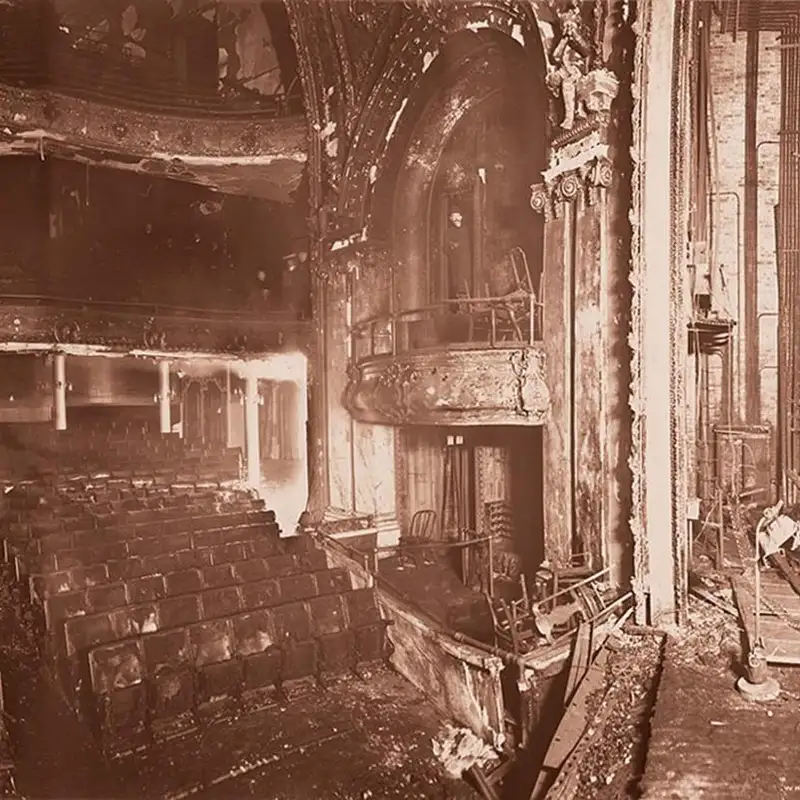
The Iroquois Theatre Fire, Part 2: The Fire
Iroquois Theatre Fire Part two On a castle terrace, in front of a backdrop painted with gardens, Fatima, believing her lover Selim was dead, agrees to marry Bluebeard. He gives her the key to the castle, but warns her not to open the blue chamber. With tunes about the songbirds of Melody Lane and the beer that made Milwaukee famous, a piano score of In the Pale Moonlight began. What also began at this very moment, 03:15PM, was a small fire caused by sparks from a short circuit in a stage spotlight. These sparks quickly spread throughout the stage in a matter of minutes, and the protective curtain above the stage, designed to keep fire from reaching the audience, never fell.
Tim Coleman:Today, Jeff Moss, Tyler J. Thomas, and I, Tim Coleman, will recount the horrific details of how this fire claimed the lives of over 500 people. This is The Three Tumblers.
Jeff Moss:If you haven't listened to part one, you need to pause this episode and go back and listen to part one first.
Tim Coleman:Also, we want to caution you that this episode contains graphic depictions of fire and deaths caused by fire.
Tyler J. Thomas:Every effort has been made to tell this story with the greatest accuracy possible. However, since records were kept differently one hundred and twenty years ago, some discrepancies may exist.
Tim Coleman:It's hard today to imagine lighting our homes with kerosene lamps. After all, how many of us have picked up our phone and turned on the flashlight function just to see our way to the bathroom in the middle of the night? But in nineteen o three, residential electric lighting was still decades away from what we are used to now. So when people would visit Chicago, they viewed the bright electric lights as almost a form of magic. Theatres were no different.
Tim Coleman:In fact, the brilliance of electric lighting illuminated the colors on all the costumes, scenery, props, and backdrops much better than oil burning lamps that were the standard up until the late eighteen hundreds. However, since commercial electric service did not have a set of codes like today, there were still issues with poorly manufactured equipment, circuit design, and a lack of safety features. It is important to note, though, even some stage lights used today put off extremely high temperatures. With all the safety protocols developed over the years, even modern stage lights have the capability to ignite flammable materials. Back in 1903, theater worker William McMullen had only been in the position of arc light operator for four months.
Tim Coleman:However, he recognized the fact that the light he was charged with operating was too close to one
Tyler J. Thomas:of the curtains. According to McMullen's testimony a year after the fire, his warnings went unheeded by theater management. I read a stat going into this researching it that nineteenth century theaters within fifteen years, 40% would have experienced a fire that ultimately closed the theater. And a predominant number of those fires were caused by lighting. Obviously here we've got electric lighting, but they had fires from alcohol fueled lights, gas fueled lights, all sorts of things.
Tyler J. Thomas:And like Iroquois, ultimately proved deadly multiple, multiple times, not just in The United States, but places like Italy, Vienna, Austria, stuff like that. So this is not unique to this fire, but it is unique, I guess, in the sense that we're dealing now, with electrical and not a fuel powered stage light.
Tim Coleman:And it's just completely amazing to me that the Globe Theatre, where William Shakespeare's plays were performed as he wrote them and directed them, actually did not burn. It was demolished. So you think back in the sixteen hundreds where torchlight was literally all they had, that's amazing considering that was a total wood structure. For the most part, it was completely wood, a tinderbox, and it did not ignite. Also, with the carbon arc lights, they were common at the time.
Tim Coleman:It was an electrical arc between carbon electrodes in air or other gas, and they were widely used starting in the 1870s actually until they were superseded by the incandescent light. But they continued to be used for searchlights and movie projectors until after World War II. You see newsreel footage from the 1930s and 1940s, you see these huge spotlights looking for enemy planes in the sky. Those are carbon arc lights. That's what we were dealing with in this theater.
Tim Coleman:So something that can produce that much heat was being focused in such a small space. I mean, it's just got to be a recipe for disaster.
Jeff Moss:I mean, I've done a lot of stage lighting. Even today, you know, stuff that's incandescent or how you you have to be very careful. We all we were always taught never to touch the bulb because the oils on your hands can cause these halogen lamps to grow like it would almost look like blister up. You you'd always have an example of what would look like. They get extremely hot.
Jeff Moss:You know, you have a 120 volt, 20 amp circuit. You got like 2,400 watts per channel. That's a lot. You you can I've had small things catch on fire. We had some very a pretty small spotlight about the size of our microphones caught a piece of the wall on fire.
Jeff Moss:And it wasn't major or anything, but lights get very hot. LED stuff is certainly better. It's a lot more energy efficient, but you still have to have a heat sink and a source to dissipate the heat. Carbon arc spotlights, you you were literally feeding carbon rod into the follow spot to make the, light. It's very old technology.
Jeff Moss:Things these days are definitely safer.
Tim Coleman:At this point, we should note that there are some discrepancies about what happened exactly. There is testimony from William McMullen saying that the light was too close to a curtain, some who say that it's short circuited, and other accounts that say someone knocked the light over. The theory of the light getting accidentally knocked over seems highly unlikely since modern stage lights weigh between one hundred fifty and two hundred pounds. As the audience watched the double octet performance of In the Pale Moonlight, they saw to the left a line of flame shoot straight up accompanied by the sound of the fuse to the spotlight blowing. Unbeknownst to the audience was that the fire had started nearly a minute earlier and had traveled along a muslin curtain despite the efforts of stagehands trying to extinguish the flames.
Tim Coleman:Muslin is a cotton based fabric having a loose weave, which means there is ample room for oxygen to permeate the fabric. This fabric had also been saturated with paint as part of the scenery backdrop. Today's stage paints, while tested and certified by the American Society for Testing and Materials, or ASTM, are still combustible depending on the time the material is subjected to open flame. In 1903, there was no such testing, nor was there any sort of flame retardant included in the formulation of the paint. In short, the scenery curtain was kindling to the fire.
Tim Coleman:William McMullen sees the flames start to raise up the curtain from the start and tries to stomp it out as best possible. Remember, fire needs heat, fuel, and oxygen. By stomping on something that is on fire, you remove the oxygen component. William Sollers, the theater's fireman, whom we discussed in part one, sees what is happening and starts trying to use the kill fire canisters to extinguish the fire. However, since the killfire devices are designed to be hurled with great force downwards towards the base of the flames, his efforts were completely ineffective.
Tim Coleman:As the fire is now beyond Salar's reach at the top of the curtain, some 50 feet in the air, it encounters thousands of square feet of the painted set canvases, props, and decorations, which quickly ignite. William Aldridge was a carpenter, but as part of the production company for Mr Bluebeard, he was operating a calcium lamp. That particular light was not needed during the moonlight dance scene, so he watched the play from a bridge 30 feet above the stage. He would later describe seeing a curtain sway, and within seconds, the fire raced up, across, and two adjacent curtains. I was about 20 feet above the lights which were being used, having left my place to watch the performance, he said.
Tim Coleman:While I was looking down on the performers, I noticed a flash of light where the electric wires connect with the calcium light. As I looked, a curtain swayed against the flame. In a moment, the loose edges of the canvas were in a blaze, which rapidly ran up the edge of the canvas and across its upper end. In a matter of seconds, the fire reaches the point of no return. So here's the point where crew members behind the scenes start to realize that the fire is going.
Tim Coleman:It is the fire has started. Started. You know, there's panic. There's realization. People know that this disaster is just starting.
Tim Coleman:That would be just such a helpless feeling. Be very scary. When the audience saw the fire run up the curtain unabated, there was an immediate hush. The singer stopped mid verse, and the musicians ceased playing. For a dreadful second, all sounds in the nearly 3,000 square foot building vanished, save for the sound of stagehands yelling at each other to beat it out or hit it with the sticks along with the quiet roar of a fire gaining its footing and spreading to everything it could reach.
Tim Coleman:Breaking the silence at first were some slight murmurings followed by shrieks and cries from audience members. Then all hell broke loose. The sounds of men jumping to their feet, women grabbing children, and kids crying in confusion erupted from the parquet, balcony, and gallery areas. It filled the space with a cacophony of fear and panic. People were running literally for their lives, not because they were surrounded by flames, but because everyone from the wealthiest to the poorest attendees, were well aware of the dangers of fire in public buildings.
Tim Coleman:So here we have just this terrifying incident of crowd panic. The fire is no longer just under the observation of the backstage crew. The audience can now see it, and their senses are disrupted. They start crying out. Once they realize what's going on, they start to just act.
Tim Coleman:There's a thought process called the OODA loop or o o d a, Observe, Orient, Decide and Act. It was developed by an Air Force colonel named John Boyd. And basically, what it describes is human behavior. We observe. We orient ourselves to what we observe, then we decide what we want to do, and then we act on that decision.
Tim Coleman:If any outside force interrupts that loop of thought, then we lose our ability to maintain within that situation and adapt to the changes that are happening around us. Now whether those changes are something as simple as rain starting to fall on us. Obviously, you're walking down the street, and all of a sudden rain starts to hit you on the head. You put on a hat. You raise your umbrella.
Tim Coleman:You take your briefcase and hold it over top of you. Whatever. But the outside force can also be something like combat or fire in this instance. So the crowd has definitely had their OODA loops interrupted, and they are not thinking clearly. And when large groups of people aren't thinking clearly, chaos breaks out.
Tyler J. Thomas:Yeah. And especially as the crowd notices, you're gonna start getting, you know, what they call fight or flight, which some people now call fight, flight or freeze. There's a few mental and physical reactions to this that are going to hurt getting out of that theater. A few of them. Number one, tunnel vision.
Tyler J. Thomas:You can just not see things as they are. Focus on one thing and that thing only. So maybe we're missing auxiliary exits and just focusing on the one door that everybody's rushing to. What they call auditory exclusion. You just can lose hearing either partially or altogether.
Tyler J. Thomas:So maybe you're not hearing people saying, This is the door we can get out of, or There's a fire, for example. You're witnessing the fire. You know there's a fire, but, you just shut down. Cognitive decline, which you're making poor decisions, or at least your decision making is hindered. And then, like I said, they call it fight, flight, or freeze.
Tyler J. Thomas:Some people in these situations, they just shut down. They don't move. They're glued to their seat because they're just paralyzed with fear. I don't know if any of this happened, but, research has shown that these are typical reactions to these sorts of events. So I have to imagine that some people experience these, maybe not all of them, maybe not altogether.
Tyler J. Thomas:It's a hell of a thing to confront. And then you don't know what you're gonna how you're gonna react. We all like to think, I'm in this situation, nineeleven, a mass shooting, I want to do this, that, or the other. That's great until you're faced with it. And then it's up to your subconscious to determine how you're even going to behave during that.
Tyler J. Thomas:So I mean we can all say, yeah, I'd immediately go toward the exit or I would start ushering people out or I'd open the door. But when you're faced with something like a fire, a life safety event, you don't know until you're there. And then the other thing too is you've got people panicking around you now at this point. They're starting to panic. It's going to exacerbate whatever you're feeling because you're having to internally deal with the fact that you're seeing a fire that's now apparently beyond control.
Tyler J. Thomas:And then you've got the stresses of people around you screaming, running, trampling, pushing people aside, trying to get out, self preservation actions, stuff like that. Not a good day.
Tim Coleman:It was at this time that stage crew attempted to lower the asbestos fire curtain. As we discussed in part one, the fire curtain had not been made as a true fire curtain, but rather had other materials that were cheaper substituted, most likely for cost saving efforts. Theatre fireman Sollars, arc light operator McMullen, and by some accounts, stage manager William Carlton called for the fire curtain to be lowered. Even though this particular curtain didn't contain the standard at the time of fire resistant material, it still could have slowed the spread of the fire. However, the automatic and manual release systems failed.
Tim Coleman:During the release of the curtain, it snagged on the light reflector and several other parts of the stage equipment around the top of the proscenium, or main arch, of the stage. This gave the now growing fire an open range on the audience. From backstage, a man in tights, loose shirt, and half applied makeup ran onto the main stage. As he ran, he called to one of the stagehands to take his son, Brian, and get him out of the building through a stage exit. Eddie Foy, the main comedic actor of the play, saw the stagehand running with his son towards safety.
Tim Coleman:From there, he was able to put on a different face, one of calm and composure, and turned to the audience. He yelled, Quiet! Keep quiet! Foy said to the orchestra to start playing some kind of music in an effort to calm the audience. Even as chunks of burning debris fall around him and orchestra members flee the stage, Foy stays calm and in center stage is still urging the audience members not to panic.
Tim Coleman:The actions of Foy, who begged calmness of the audience, probably saved many people who were seated on the percave floor. Although human nature to panic ultimately prevailed, his coolness stayed many members of the audience, keeping them in their seats just long enough for the exits to open up.
Tyler J. Thomas:God bless somebody like Eddie Foy. You need those kind of people in these situations. We've heard it, all kinds of events going on. Like we talked about earlier, Rick Wascorla, even though he briefed and trained employees what to do in an event. They nineeleven he didn't survive it but they found him on the stairwell saying everybody let's get out of here.
Tyler J. Thomas:Let's let's go back to what we did what we know. Let's let's stay calm. We're gonna get through this. Let's do this. And he just kept going back up to make sure everybody got out.
Tyler J. Thomas:But you need people like Eddie Foy and and Rick Waskorla in these situations. And when you get them, as history has shown, things go a lot better.
Jeff Moss:Yeah, I mean I remember in college like freshman year they had us do a training thing you know what happens when you're in a room full of smoke and it was very scary. I mean, it wasn't real smoke, but it's very hard to orient yourself and your senses and all that. I mean, these people were certainly heroes because most people would worry about themselves, not help the others. They certainly sacrificed themselves.
Tim Coleman:And I think a look at what Eddie Foy's actions did was, as I was just saying before, he actually, by grabbing people's attention, he actually helped to reestablish and preserve their UDA loops. I know that's a really funny name, to keep saying, but that whole loop is how human beings operate. It doesn't matter where you're from, how educated you are, what language you speak. We all have that same process. Observe, orient, decide, and act.
Tim Coleman:If you can have somebody focus that process for you, it greatly increases your chances for survival.
Tyler J. Thomas:Yeah, even just having some sort of semblance of authority or rationality where somebody's in charge. Maybe it's him. I don't know why, but it's him. Yeah, okay. Let's follow it.
Tyler J. Thomas:Let's work. Heard mentality. You know, crowds moving together. Doesn't necessarily have to be the right or the best decision to make at that point, but the fact that he's trying to restore order, maintain calmness, like I said, it's gonna do a world of good. Can't do any hurt.
Tyler J. Thomas:I mean, it's not like he's saying fire, panic, run. He's saying calm down, Let's manage this and try to get out of here.
Tim Coleman:The vents above the main stage that had been designed as fire suppression devices to allow smoke to escape were sealed shut, so smoke could not get out of the building. By
Jeff Moss:this
Tim Coleman:time, smoke is pouring through the upper areas of the auditorium starting to build up downwards towards the audience. By this point, all sense of calm and understanding have completely left the people in the audience. Panic has set in, and everyone is rushing towards the exits. However, those exits have the bascule logs we previously discussed. They require at least four separate motions to unlock each door.
Tim Coleman:That is, if you could find them behind the wall curtains. One such door was even being blocked by an usher. Frank Houseman, a former Major League Baseball player for the Chicago Colts, tells the man to get the hell out of the way, and he opens the door. Houseman had a bascule lock on his icebox at home, so he knew how they operated. Houseman's friend, Charlie Dexter, another Major League player, uses sheer brute force to open another door.
Tim Coleman:After the fire, investigators found a third door that was opened. However, they were unable to determine if someone had opened it, or if a blast of air did. At the doors that cannot be opened, panic grips the people literally piled up behind those trying desperately to escape. Women and children are trampled and crushed by men trying to flee the building. Those at the doors are literally smashed up against them.
Tim Coleman:At these exits, there is no room and no time for someone to examine the bascule logs and figure out how they are operated. Other groups of people rushed to supposed exits only to find that they are ornate windows meant to look like doors. On the other side of the proscenium, the grand archway, actors, production crew and stagehands were also in panic mode. As they attempt to flee, they find the building's main rear exit, which are massive double doors used to move large pieces of the set in and out of the theater and escape onto Dearborn Street and Couch Place. Performers that couldn't escape through these doors also used the coal hatch and windows in the dressing room.
Tim Coleman:Still more also find an exterior stage door, but since it opens inward and between four and five hundred cast members are all trying to escape, it is impossible for those at the front to pull these doors inward against the flow of people.
Jeff Moss:Yeah. I mean, this is why we have panic hardware and single motion egress because you can push it with anything. There's no special knowledge required. You don't have to make any weird movements. Sort of natural to just walk into it and open it and none of that happened.
Jeff Moss:So that's very scary. But it's something like this could not happen with our hardware standards today, for sure.
Tim Coleman:You know, something that I've been trained on for years in my previous career in law enforcement was muscle memory. When you do something over and over again and repeat that motion, it doesn't matter how much of an adrenaline overload that you might be having in a situation, your muscles react naturally to that same motion no matter what it is. So these people really didn't stand a chance because nobody unlocks these doors every single day other than Frank Houseman who happened to have a lock that was very similar to this on his icebox at home. That's why I think he was able to come through and get the door open for or get one of these doors open for these people to escape because he had that muscle memory in that time of panic.
Tyler J. Thomas:Yeah. And if if you kinda wanna hear a morose detail about it, current life safety codes kind of protect and account for this. For example, if you're already injured, for example, you're going to need as much help as possible. That's the way life safety codes and hardware is designed. For example, NEC, National Electric Code, IBC, International Building Code, a lot of these codes have requirement for exit devices, panic devices, to be used on rooms housing high voltage and high amperage electrical equipment.
Tyler J. Thomas:So the thought is if you have something bad happen like an arc flash, if you're lucky enough to be alive, still conscious, you're probably not going to be in the best of shape. So you just need to find an exit and just basically run into it, crash into it. That's why they call them crash bars. And just get out and hopefully find somebody that can help you. So as bad as it sounds, exit devices, like Jeff said, you just want to run into something and you get out.
Tyler J. Thomas:Don't necessarily have to be injured. Maybe you're just in a panic, but either case, the fact that these hardware pieces exist to facilitate egress, it's basically why. You've got to help out the people that are in there. Either they're injured, they're panicked, they're confused, whatever it may be. You're now providing them with that opportunity by way of hardware to get the hell out of there.
Tim Coleman:Yeah, it's simple. It's you can open it with very little effort. So if you can all you can barely do is throw your body against the door, you can, in theory, get
Tyler J. Thomas:to safety. Even current ADA, you know, Americans with Disability Act requirements have things such as pounds per square inch or feet or something like that, the amount of force needed to open. So in other words, we've got an eighty, ninety pound door, maybe 200 pounds if it's rated for three hours, whatever it may be. We only need like eight, ten pounds of force to open that door. So you can be 80 years old, frail, feeble, by law, you should have a chance to open that door.
Tyler J. Thomas:Or you're injured or you're young like us, 30s, whatever it may be, and you just kick that thing open. But whatever it may be, they're giving everybody, the laws are giving everybody a chance to have egress through that door. No matter the size of the door, no matter what's on it, you just need just a little bit to get it open, get it swinging, get out. Hopefully everybody's abiding by ADA and FPA requirements, whatever it may be. But they are the law.
Tim Coleman:With vents above the stage effectively sealed off, and no fireproof curtain between the stage and audience, the fire is massive. As cast members open the backstage doors onto Dear Dearborn Street, there is a massive influx of oxygen introduced into the building. With smoke having filled the upper third of the volume of the Iroquois Theatre, and having plenty of heat, this introduction of fresh oxygen is the last ingredient this tragedy needs. This deadly trio ignites an event known as a flashover. To put it simply, smoke is the unburned parts of a fire.
Tim Coleman:That's not to say it isn't flammable or combustible. In fact, when unburned smoke is trapped in an environment that contains high heat, the smoke itself becomes a fuel for the fire when conditions are just right for a flashover. The entire open space of a structure erupts into a giant inferno. As a side note, most modern firefighting techniques include ventilation of a structure that is on fire. For instance, if a house is on fire, then firefighters will go up on top and cut several large openings in the roof, thus allowing combustible smoke to escape into the open atmosphere before it has a chance to flash over inside.
Tim Coleman:Since the vents for the Iroquois Theatre are sealed shut, however, there is nowhere for the smoke to go, now making it a prime fuel fuel enforcement. But what they may not know is that I also have a background in firefighting. I was a firefighter EMT for about five or six years in my late teens, early twenties. And the flashover simulators, I never actually got to participate in one in person, because those classes fill up so quickly. But when I would see it, it's basically like a large cargo container, a steel cargo container that you might see on the back of a tractor trailer, but it's set on the ground.
Tim Coleman:And what they do is the instructor start a fire with, normally, with pallets and hay and diesel fuel in front of that container. And then there are seats for all the firefighters to sit in. Now, of course, fire fighters are in their protective turnout gear, nomax hoods, helmets, self contained breathing apparatus or SCBAs. And you sit in these chairs and basically let the smoke build and build and build until it reaches that point of ignition. And when it does, it ignites all of that smoke that is trapped inside of that container in an instant, and the entire place becomes just a huge fireball.
Tim Coleman:And when you see these firefighters come out, on where they were sitting, the face shields for their helmets have been melted, turnout coats have been just turned completely black and are charred, gloves are charred. It is just incredible to see what can happen in a controlled training scenario. So I can't even begin to imagine how the Iroquois Theatre looked when this happened.
Tyler J. Thomas:You know, as as we were researching this and reading about this point, the the thought I came up with, have you all seen that movie Inglorious Basterds with Brad Pitt and all that? The last scene where she sets the cinema ablaze to kill all the Nazis and all of that, there is a flashover of sorts at the end. And that's kind of what I imagined, you know, it looked like here. You've got people scrambling towards the exits, which, of course, they've locked. It's it's Hollywood and all of that, but just a massive fireball erupts from the stage, which is where the ignition point started here, where the fire started, and moves towards the back of the gallery.
Tyler J. Thomas:Kind of the of the same thing. I mean, that's basically what it looked like.
Tim Coleman:In the alley of death and mutilation, jumping from the fire escapes to escape the flames. Headline of the Chicago Daily Tribune, Thursday, December '3. The people who were fortunate enough to not be incinerated in the flashover event still faced nearly certain death or injury. Balcony and gallery occupants raced towards the stairways leading down to the grand foyer, only to find them blocked by accordion style iron gates. Knowing that they would almost surely die if they attempted to proceed through these massive gates, they most likely turned and headed towards the fire escape exits.
Tim Coleman:Once out, on the north side of the building, over Couch Place, they found that some of the fire escapes were not installed correctly. This trapped people, yet again, with no safe means of egress. Some of the showgoers actually tripped and fell off of the fire escapes. In a gruesome twist of fate, it has been reported that the bodies of these victims actually cushioned the falls of additional victims, thus saving more lives.
Tyler J. Thomas:Yeah. As morose as that sound gruesome, as we move through future series dealing with life safety, we're gonna find out that that's a common trait that, you know, landing on bodies is is sad and depressing as it sounds. That ultimately saves lives. Being at the bottom of one of those piles can also save a life because the people on top of you are the ones experiencing, you know, the flames hitting them or the flashover or what it might be. Well, and I
Tim Coleman:think it's also important to mention to our listeners that the reason why people were falling was due to the construction of these fire escapes. I mean, the threshold of the door leading outside to the fire escape landing was nearly two feet above that landing platform itself. I mean, I've taken a step down, you know, some steep stairs or even the steps on my own front porch. And when you misjudge that six inches, you have that feeling of, my God, I almost died. You know, even though you just forgot that there was an extra inch to go until your foot landed.
Tim Coleman:So imagine being in this panic with all this going on around you, and then you've got, like, a 20 inch drop to where you're supposed to be stepping out to. I mean, it's almost comical if it wasn't such a tragedy of a situation that we're looking at.
Tyler J. Thomas:And that's why building codes have requirements or thresholds for tread depth and tread height so that this doesn't happen again, so that what you're going to experience is gonna be within a range that's manageable or something that you're already familiar with.
Tim Coleman:On the other side of Couch Place, to the north of the Iroquois Theatre, was a building that belonged to Northwestern University. Painters working to repair damage from another fire were able to bridge the gap between the two buildings, first using a ladder and then using wooden boards between the rooftops. Thanks to their efforts and compassion, several lives were saved that day. One life that was not so lucky was the twelfth person in a dozen trying to leave by going across one of the plankways when they were engulfed by a pillar of flame. Women and children packed several other fire escapes.
Tim Coleman:They were consumed and burned alive by spouts of fire erupting from the building. Some of their bodies fell over the edge and landed dozens of feet below in the alley. Others died in the openings of the buildings. Literal piles of bodies were being created. An amazing story out of this hellish inferno is that on stage exit level, where actors and crew members are literally piling up on each other trying to push out on inward swinging doors, A nearby railroad agent sees them, and by a miraculous chance, he has his hand tools on him.
Tim Coleman:He manages to remove the hinges so that the door can be pushed to the side, and the performers and crew can escape the blaze behind them. That's one reason why I always have my lock picks with me. In case if I get trapped in some place. Now, obviously, a fire is not going to be great environment to try to pick a lock to get out, although you shouldn't have to. But there are other situations, you know, like simply pulling the door shut behind you and not realizing that it's locked.
Tim Coleman:So carrying tools with you is pretty cool.
Jeff Moss:Yeah. I mean, always have tools in my car, not, obviously, a full set. I don't typically carry them on me, but I always have tools nearby just in case.
Tyler J. Thomas:Yeah, kind of the same thing. I've always carried a center punch in my car, hopefully to get out, but you never know when you got to break glass somewhere. Yeah, you've got to, you know, they make safety kits, tool kits, first aid kits, whether we use them in camping or just keeping on your automobile on your person. But yeah, it can help. But I don't know if I were ever broached with the same situation that I could, I had everything it would take to take off the hinges of something.
Tyler J. Thomas:I don't know how I'd react in that situation.
Tim Coleman:Or also, if you did have those tools and the knowledge, but the hinges are just so beat up over the years. They've not been serviced. They've not been lubricated. Hinge pins just don't pop out of the hinges. Even if you have the tools to do that, you have to apply some force.
Tim Coleman:So unless if you're carrying around a punch and a hammer in your pocket, then you're you might not be able to get those hinge pins out if that's the route of egress you need to take.
Tyler J. Thomas:Especially with ball bearing hinges now, they're 9% of commercial hinges. I don't I wouldn't even know how to begin to take one of those apart just using hand tools.
Tim Coleman:Another point that I'd like to make about this is that some of these victims had the decision, do I burn to death? Or do I try to escape and then fall to death? Now, I've been in fires. I've been in house fires before. I'm not scared of fire.
Tim Coleman:I have a very healthy respect of fire. But I know what it can do, and that's not a fate I would like to see. However, my biggest phobia in life is the fear of falling. I'm okay with heights, but falling from a height, even from the top of, say, a six foot ladder, there moments that I have at work where if I don't feel completely secured at the top of that ladder, I start to get nervous and can actually panic sometimes. I've learned how to control that, but the higher I go, the harder it is to control that panic.
Tim Coleman:So that would be a nightmare situation, knowing for sure what would happen if I went back into a fire versus falling forty, fifty, 80 feet to hard ground below? I just don't know what I would do.
Tyler J. Thomas:Well, personally, I'm jumping and I don't blame any of the jumpers of nine eleven for that same sort of decision making because heat, flames, all that. It's miserable. I I at my old house cleared half an acre of woods, burning it little by little and got too close to the fire a few times singe hair and all of that. Even that split second of heat that's unbearable. I can't imagine when it's going on constantly around you and you have nowhere else to go.
Tyler J. Thomas:I I don't wanna go out burning alive. I'd rather jump and just whatever happens may happen and probably what's gonna happen is not gonna be good.
Tim Coleman:Eddie Foy, the brave actor who had stood center stage trying to maintain calm and order, had, by this time, managed to make his escape. Along with him were members of the aerial ballet, who were the last of the performers to get out of the building. The aerialists owed their lives to the boy in charge of the fly elevator. While they were aloft in the first and second fly galleries above stage, and burning debris fell around them in the thickening smoke, the elevator boy ran his cage up to them, took the performers aboard, and brought them safely to the floor. One aerialist performer was not so lucky however.
Tim Coleman:Nellie Reed, an acrobat, was trapped by a wire still attached to her for her performance of flying over the audience. She was one of only two cast members who died that day. As Foy and the group of aerialists reached the outer doorway, the stage loft, along with other hanging, hand painted scenery backdrops crashed to the floor with tremendous sparks, flames and billowing smoke. The Iroquois Theatre had no fire alarm or telephone. So outside of the building itself, virtually no one had any idea what was going on inside.
Tim Coleman:The Chicago Fire Department engine was alerted and en route approximately eighteen minutes after the fire had started. They were only made aware by a fleeing stagehand. One of the firefighters actually stopped along the way to activate a nearby fire alarm box to call for additional units.
Tyler J. Thomas:You know, as we're we're navigating through the series of events here, I I have to wonder if the set pieces, which were basically canvas with oil paint, wood frames, were not there, would this fire have escalated to the point it got to? Otherwise, would it have just ended with the curtain?
Tim Coleman:Where would it have spread to? That's a that's a really good point, Tyler. You know, how far would this fire have gotten if the fire extinguishing systems had all been perfect and everything operated as it should?
Jeff Moss:Yeah. I mean, we talked about we've where I live, we've always had 09:11. So that's not like you have to hunt around for a number to call. But again, with there being no detection and no phone, I mean, it's really scary. You'd have to run out to a street corner to pull a pull a fire alarm box and not have something like that in a building.
Jeff Moss:It's not thought of now. Mean back in the day the municipal fire boxes were everywhere. Basically a telegraph system with a box that had a code attached to it and each box would transmit a different number and they would look up where that was. Now, one hundred and some years later when the fire alarm goes off it can tell you exactly what detector in what area it is and they know exactly where the problem is. So part of that is that you don't even know that it is a five alarm fire at this place.
Jeff Moss:You just know that something went off.
Tyler J. Thomas:I think that was too part of sort of the conflict between the Fire Department of Chicago and the leadership prior to and shortly thereafter of the Great Chicago Fire. They wanted more funding for more equipment, more personnel and the compromise was these fire boxes around the city. So imagine if the great Chicago fire doesn't happen and maybe that changes trajectory where the Iroquois Theatre doesn't exist or whatnot, but the fact that there was one fire box within reasonable proximity and alerts the fire certainly helps, with those still trapped inside or those trying to make escape. But, you know, I I wonder if if that had never happened, does the death toll become immensely greater?
Tim Coleman:Right. I mean, the closest fire station, the fire station that actually responded was less than four blocks away from the Iroquois Theatre. But their response time from the start of the fire until their arrival time was nearly twenty five minutes. I mean, that's a lot, but most of that was just due to the fact that it took so long to notify them. You know, somebody running out from the theater knowledge of what was going on, going to that
Tyler J. Thomas:alarm box and getting the word out. And and then those that are there probably from out of town, I mean, in the suburbs or or blocks away, if that firebox had not existed, would I mean, how many of those that were able to make escape or egress, how many would know that that fire department stations four blocks away? Who would know that?
Tim Coleman:The initial efforts of the fire department focused on the people trapped on the fire escapes. Since the alleys between buildings are very narrow, they quickly filled with smoke. Ladders and nets proved to be useless since the victims cannot be seen from the ground. By this point, if victims hadn't found an exit and gotten out, their fate was almost certainly sealed. Although the initial flashover was over, suffocating smoke and deadly heat still permeated throughout the building.
Tim Coleman:By the time the Chicago Fire Department arrived, very few people were rescued alive simply because there weren't many left to save. How can we get down there? Jump. We'll catch you. No.
Tim Coleman:We'd fall. Swear if we descend, you'll treat us right. Let us swear it by the pale moonlight. We love you blindly. Let us wear it in the pale moonlight.
Tim Coleman:We thank you kindly. Then we take it that your word, your plight that we won't be kissed. Lyrics from In the Pale Moonlight, the song that was being performed in the fire ignited in the Iroquois Theatre.
Jeff Moss:Next time on The Three Tumblers. Beyond horrific.
Tyler J. Thomas:Nobody plans. Nobody anticipates six hundred people. Almost six hundred people dying in one day.
Tim Coleman:You are going to be in a rush. You are going to be terrified.
Jeff Moss:It's not a lock problem.
Tyler J. Thomas:Mentioned at the start of this episode, these events occurred over one hundred and twenty years ago. Accurate records are no longer available to the producers of this podcast. All facts stated have been verified as best as possible whenever possible.
Jeff Moss:Executive producer is Tyler j Thomas. Technical producer is Jeff Moss. This episode researched and produced by Tyler j Thomas and Tim Coleman. Written and edited by Tim Coleman.
Tim Coleman:This has been a Three Tumblers production. Copyright 2023. All rights reserved. Find this episode and others wherever you get your podcasts.