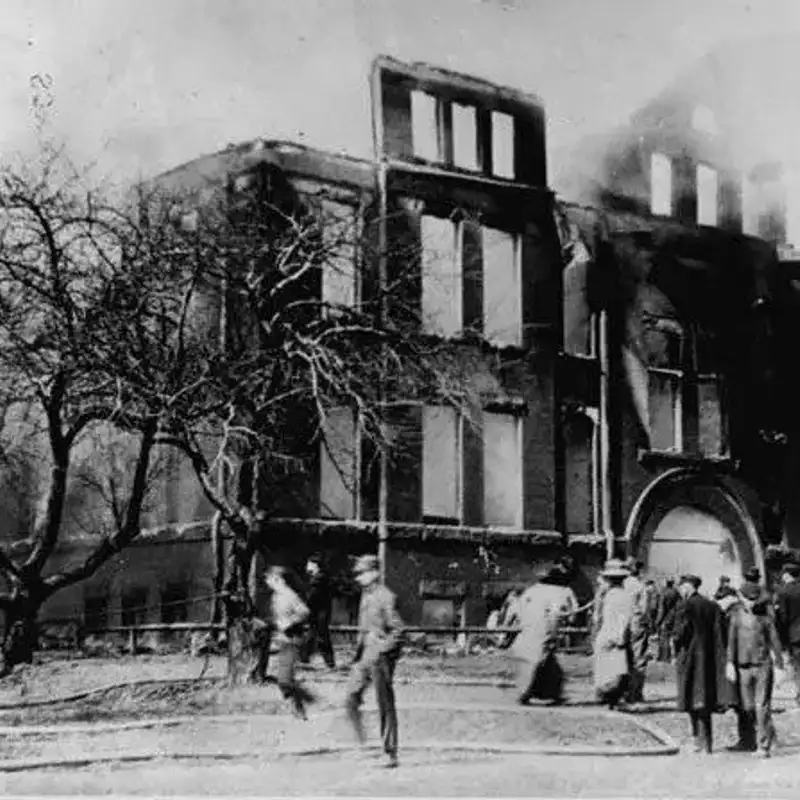
Lake View School, Collinwood Ohio, Part 2: School on Fire
13 year old Emma Nebert left her home a little after 8AM to go to school, like she did most any other day. The chilly morning air and light snow on the ground made the walk brisk. Once she arrived through the main entrance on Collamer Street, she went to miss Bodie's classroom on the 3rd Floor. After starting the school day with a prayer, classes began. When the bell rang at 09:30, Emma excused herself to go to the washroom in the basement.
Tim Coleman:That's when her entire life and the lives of every other person in the Lakeview School would forever change. Today, Tyler j Thomas, Jeff Moss, and I, Tim Coleman, will take an in-depth look at the fire that caused so much destruction one hundred fifteen years ago in Collinwood, Ohio. This is The Three Tumblers.
Tyler J. Thomas:This is part two. If you have not listened yet to part one, you need to pause this episode and go back to listen to part one. In this episode, we will be discussing graphic depictions of the deaths of children and fire. Listener discretion is advised.
Jeff Moss:While we have attempted to ensure the accuracy of the content for this episode, these events occurred over one hundred fifteen years ago. While there are many records of this fire, there are also some discrepancies.
Tim Coleman:We will provide a list of source material for this story on our website, 3tumblers.com. Now, The Lakeview School Part two, School on Fire. 26 year old Grace Fisk had entered the school well before her third grade students began arriving. Grace was born in New York, but later moved with her parents to Collinwood. Her father was a tremor on a steamship and her mother was a housewife.
Tim Coleman:Having become a teacher at age 26 is still not uncommon even today nor is being unmarried and living with your parents. The house at 10522 Orville Avenue was only a few blocks away from the school, so the daily walk was easy. As her students began arriving a little after 08:00, there were the usual greetings and grumblings from students as they put away their coats and got their books, papers, and pencils ready. With 49 students, the room was completely packed. Overcrowding was a serious issue at Lake View.
Tim Coleman:As we discussed in part one, the significant increase in population in such a short time led to issues throughout the village. Every classroom in the entire building was packed full. Even the 3rd Floor gymnasium that had been converted into classrooms was full of students. On that day in March, 350 students packed into a building that had been designed for only about 200. This forced teachers and staff to crowd the desks together and cram the kids in tight.
Tim Coleman:Children were typically less than an arm's length away from another classmate. This overcrowding also forced architects to build in additional wardrobe spaces in the school during the nineteen o six expansion. As a result, wardrobe rooms were constructed around the stairways as well. Also, during the expansion, partitions were added at the bottom of the stairs. These partitions contained doors that opened into vestibules between the bottom of the steps and the exterior doors.
Tim Coleman:These doors were not like any that you would ever see today in any commercial or even residential building as they were only 28 inches wide. That's about eight inches narrower than the front door on your own home. In addition to having narrow doors, students have to make a quick turn or step around the partitions in order to have a clear path to the exit doors. For a modern day comparison, imagine leaving a grocery store. Typically, there are two sets of automatic sliding doors to walk in and out of.
Tim Coleman:You are walking out through the doors and are almost out, except that the door you are closest to doesn't quite roll back all the way and you kind of get shoulder checked by it. Well, at Lakeview, the doors were certainly not automatic, and the openings from the stairs to the exit doors did more than just body check the children trying to escape for their lives.
Tyler J. Thomas:So last episode, I talked about occupant load or basically the number of people in a building as well as egress capacity, which is basically how well that building is designed to those people out of the building. I made the critique that when they added to the school, essentially increased the occupant load without increasing the egress capacity. But as we just heard, they didn't just keep the egress capacity the same, they actually decreased it. So now you've got more people, less exiting. And if you think about it, 28 inches is is really nothing.
Tyler J. Thomas:Most residential doors are three foot wide, most commercial doors are three feet wide, but it's not a lot of room to go through when you're dealing with multiples of people. Yeah. We're not three feet wide, especially children, but if you gotta get out of the building, I guarantee that you would want as much additional room as possible. Maybe you're not going out side by side, but like I said in the Iroquois series, with modern life safety codes, at least want that chance. Will it matter?
Tyler J. Thomas:Yeah. Who knows? But you want the chance. You know, it's it's like, keeping a firearm on your person for self defense. Do you really need that many rounds?
Tyler J. Thomas:Well, hopefully not. But if push comes to shove, you'd rather say I had too many than I had too few. Same thing with the width of egress or egress capacity.
Jeff Moss:It it's crazy to think of a door being two and a half in two and a half feet wide or anything other than like a broom closet or a pantry. Again, was it that they didn't know any better? Was it cost savings? Was it as they say, was it the style at the time? I don't know.
Jeff Moss:I don't know the history of door widths and and things like that, but, you know, at some point they realized, hey. We gotta be able to we need to make the door wider, you know, for a wheelchair or something like that, but, you know, I guess I don't know when they sort of standardized on having a three foot wide door in most cases. Seems weird to us, but maybe that's how they all were back then and people just were smaller or had to go sideways or, you know, certainly been in old buildings where the all kinds of stuff is weird to us. You know, we had our Masonic temple downtown. There's all kinds of hallways and doors of different sizes and just construction things that's not done anymore.
Jeff Moss:So it was the way they did it back then and it's not right now.
Tim Coleman:I'll have to say that when I first started working as a school resource officer, my first day on the job doing that, I was training with another officer who had been in the school and the bell rang. And again, never having had that experience, Terry, the officer that I was working with, he said, you need to step back over to here. Because within thirty seconds, the halls were flooded with literally 550 kids trying to go from place to place to place. And I was just blown away just by how crowded that was. And then looking more, there was an elementary school that had absorbed the student population from an older school that had been closed, and they had so many kids in that building.
Tim Coleman:Looking back on it now, I don't see how they got away with it, but they are they had so many kids in that building that they were literally having classes in the hallways of that school building, and that's just that just seems ridiculous to me now after having done all the research for this and knowing the history behind these types of events. That does not seem smart to me looking back on it. And so when you think that you have that massive just just that massive children in an emergency as we're about to hear crowding for the doors, you definitely want doors as wide as possible and as many of them as possible.
Tyler J. Thomas:I can only recall one exception to IBC that allows for a door to be 28 inches. I mean, that's the bottom threshold of it. It's gotta be 28 inches or more, and that's a resident sleeping units, which is part of group I three, but definitely not a school.
Tim Coleman:After the 09:30 bell rings and classes start to change, Emma Nebert asks miss Bodhi if she can be excused to use the washroom. Located in the basement, Emma walks down the flights of stairs, but stops just short as the steps begin descending into the basement. She sees and smells smoke and knows the dangers of fire and what it could mean to everyone. Fritz Herder, a German immigrant who is the school janitor and maintenance man, is working on one of the boilers at the time and hears Emma's calls. Seeing the smoke, Fritz rushed to ring the school's fire bell to alert teachers and students to evacuate the building.
Tim Coleman:Emma ran back up the steps and out the east main entry door. With amazing clarity of mind, she thinks to hook the door open. While the doors did not have closers like we think of them today, they did have springs that would pull them back shut. She waits outside the building for her friends to start coming through the doors. Meanwhile, Herder runs to miss Irwin's classroom in the Northeast corner of the 1st Floor to ring the fire bell.
Tim Coleman:This bell only rings within the school itself and could be heard outside only by those in close proximity to the building. It did not alert the Collinwood Fire Department in any way. Ruby Irwin, having been alerted to the fire by Fritz running into her classroom to ring the fire bell, leads her first grade students towards the east exit just like they had practiced in drills. Only half of her students make it out the main entry before the smoke, flames, and heat force them to return to their classroom. By this time, the fire is racing through the basement and up the wooden staircases.
Tim Coleman:The brick walls and wooden interior make the school like a huge fireplace with all the heat and smoke rushing straight up as it would in a chimney. With the partitions at the bottom of the stairs, just feet from safety outside the building, some of the children tripped and fell in those doorways. Other students ran over top of them, but still more tripped and fell on top of the ones already on the floor. Since the younger children were on the 1st Floor and older children on the upper floors, there was no hope for the little ones to get up through the crush of bodies on top of them to escape the smoke and flames surrounding them. Up on the 3rd Floor, Laura Bodie, Emma's teacher, had only been with the school for five weeks and had not participated in the one fire drill held that year.
Tim Coleman:Her students all line up as they had practiced and head down the stairs to the 2nd Floor. But the children start to panic when they can't go any further due to the smoke and flames racing up the steps. So Laura gets most of them to follow her to the fire escape on the north side of the 2nd Floor. Some of her students refused to follow her directions and tried to escape down the West Stairway. This refusal to listen would end in their deaths.
Tim Coleman:So I think here we have to recognize that both Fritz Herder and Emma Nebert were heroes of the day. I mean, Emma, only being 13 years old, alerted him to the the presence of fire and smoke in the basement, and Fritz telling her to to get out of the building and running up to the one and only place that you can sound the fire alarm in a 1st Floor classroom, which sounds ridiculous today because we have pull stations everywhere if the fire isn't automatically detected. And for him to do that and then you also think about these teachers trying to get their kids, you know, out safely and nothing is going according to plan. They just they they were heroes trying to get their kids out and we'll hear more about that in just a little bit.
Tyler J. Thomas:Well, think too about how lucky the survivors were because if Emma doesn't have to go to that restroom, that washroom, there's no guarantee that Fritz can catch it or maybe he does, but maybe he's trapped by the fire, he overcome or is overcome by smoke inhalation or whatever it may be. So the rest of the school might not get warning until that fire is already up on the 1st Floor blocking the entrance, one of the entrances and going from there. He just talked about luck. She had to go to the restroom at that time, notices it, and then, like you said, they they start acting to to let others know.
Tim Coleman:And also, goodness that for once, thank goodness, that all the restrooms are in the basement where the fire started. I mean, if there was a a 3rd Floor restroom, then she would have never been down there and she might not have made it out.
Tyler J. Thomas:And it's it's crazy that the the fact that the fire is already so intense at this point that the first group of kids to evacuate can't all bypass it. I mean, it just shows how bad it was. So to put things in perspective in the best conditions or worse depending on how you're viewing it, a timber fire like this can reach just over 1,100 degrees in roughly three minutes. So that's almost hot enough to melt aluminum and we're just three minutes in. So on top of that, you've got that chimney effect that we talked about, at the beginning of the first episode.
Tyler J. Thomas:The interior is burning and the exterior walls are containing it, radiating that heat back. So we're starting to see why fireplaces are designed the way that they are. You've got stone, usually brick, as the case here, surrounding wood. The wood burns, oxygen's pulled from the room, and the heat radiates from that fire. And what isn't immediately radiated is held within that brick and sit back out, albeit not as intense.
Tyler J. Thomas:So this is the fire triangle triangle we talked about in the Iroquois series. The radiating heat is the goal of the fireplace. That's why we have them. But here, it's intensifying the effects of the fire almost from the start.
Tim Coleman:The second graders in miss Catherine Weiler's class on the 2nd Floor were singing songs when the alarm sounded. When the kids headed to their practiced exit on the west stairs, they found a massive wall of students who were trying to escape after the east stairs became blocked. As miss Wyler tried to get her students to the fire escape on the north side of the building, she managed to throw several out of a window to safety before being trampled by terrified students. The west stairs then collapse, sending students and Catherine through the floors to their deaths. Miss Lulu Rowley leads her third graders to the front east stairs, but they were already blocked by fire.
Tim Coleman:Seeing that there is a complete jam of children at the back stairs, she orders her kids into Grace Fisk's room along with miss Irwin and the remainder of her students. Together, they manage to open and break out windows and start throwing children out the six to eight foot drop to the ground. One boy is badly cut and cannot see because of the blood in his eyes, so miss Rowley picks him up and carries him to safety outside. Knowing the boy is out of danger, she runs to the rear door, but is confronted by the horrible sight of child upon child, stacked like logs in the entrance. Fire and smoke surrounding them.
Tim Coleman:Grace Fisk is still in her classroom after miss Erwin manages to escape out the window. As smoke and fire consumed the building around them, she still tries to get every child out to safety. Panic sets in, and the remaining students trample her in their efforts to flee. As she laid on the floor, injured and bleeding, she still managed to take two small children and wrap them up in her skirts in an attempt to protect them. They saw the flames leaping up from the basement.
Tim Coleman:They screamed, broke ranks, and ran for the front door. It would not open. The mass turned to the rear door. It would not open, and it was shut. Those in front tried to open it, but the ones in the rear pushed against them, and the little bodies were crushed to death.
Tim Coleman:Others suffocated. It was too dreadful for words. Miss Anna Moran, principal of the Lakeview School. We talked about how the kids in in a school, just normal day to day going through the hallways, there's just literally this wall of children moving. And so now you introduce smoke, you introduce fire to that.
Tim Coleman:Panic has set in. Look at these teachers. What they are doing trying to save these kids? I mean, they're they're trying to get them out the fire escape. They're trying to get them into other rooms when they see that the main entrances and exits are blocked off.
Tim Coleman:They're breaking out windows, throwing kids out. They're, you know, grabbing a child who can't help himself and literally jumping out the window with him to save his life. And then they can't get back in because there's just this massive blockage at the doors. No way to get back. I mean, we were talking just a minute ago about heroes.
Tim Coleman:These teachers teachers were real heroes of the day trying to save these children.
Tyler J. Thomas:Yeah. I hate to sound callous or not, but in these situations, especially, you know, nine eleven where they had to break the windows to just breathe. But you also have to realize that that's aiding the fire. It's sucking in more oxygen now. So it's kind of damned if you do, damned if you don't situation.
Tyler J. Thomas:You gotta get out. You gotta save as many lives as you can, but ultimately, you may be dooming those that are still inside because now the fire is getting more oxygen. Now it's getting bigger. Now it's feeding. So I like I said, damned if you do, damned if you don't.
Tim Coleman:Well, and at the one point where the 2nd Floor collapses into the 1st Floor and then both of those floors collapse down into the basement, I think one open window or or three or four open windows at that point isn't really gonna make that huge of a difference to feeding that fire because it's already spread. We're only five minutes in from when the time that, you know, Emma started seeing the smoke at the top of the steps going into the basement. I mean, this is five, ten minutes at the most at this point. This fire is just spreading that quickly and is that intense.
Tyler J. Thomas:I mean, do you know how hot it has to be for a structure to collapse within five minutes? I've burned pallets and and wood and all of that stuff, and it takes a while, but now within five minutes, stuff's already collapsing on itself. I mean, that it had to be tremendously hot in there.
Tim Coleman:Yeah. I mean, is you think about it, like we said, there's construction of yellow pine all throughout the building. And not just the yellow pine for the timbers and flooring and the lath on the walls, you know, which was covered by plaster, but you also think you've got desks and chairs and you've got, you know, probably some pictures, some printed maps in rooms for geography lessons. You've got all of these combustible materials and and and then you have wax on the floors. You have furniture polish.
Tim Coleman:You have books. I mean, what's a school without books? So you have all of this combustible material in what is essentially a three story, four story chimney, if you count the basement, and you also have coal storage in the basement. So something that I never really found in my research for the episode was did the coal storage actually ignite? But if it did, could you imagine the heat coming off of that?
Tim Coleman:I mean, you have two, three tons of coal. I don't know how much they they kept on hand, but you think if you have at least one ton of coal that all catches fire at once, there's a reason why they shovel coal in, a shovel full at a time to boilers. So you've got just this huge furnace going. So it really doesn't surprise me that it only took just a few minutes for the for the fire to spread that far. Plus, we also don't know exactly how long that fire had been going before little Emma comes down the steps into the basement.
Tim Coleman:And Fritz working on the boiler at the time, he may not have have smelled it or or observed the smoke or or any flames just because he's in that close proximity to the boiler. And when, you know, when you're in the thick of things like that, you don't necessarily smell or see other signs of of trouble around you.
Tyler J. Thomas:Yeah. I think too now that now that we talk about it with yellow pine, the reason you don't burn pine in fireplaces is because the amount of creosote it produces. So if it's burning, it's producing a tremendous amount of smoke. So never mind the heat. Well, the heat's bad enough, but now you've got the worst possible wood in terms of smoke producing.
Tyler J. Thomas:It's gotta be producing tons, I don't know how they manufacture stuff. And these days, pine's pretty much only used for cabinetry and and stuff like that. Certainly not doors and and and framing and all of that anymore because it's so terrible. But, yeah, I I it's exacerbating everything. Coal with the heat, yellow pine with the smoke.
Tyler J. Thomas:Yeah. As we round this out, it it reminds me, of my great grandfather. He was the police chief of East Point, Georgia for about twenty three years. Worked with the department far longer than that, started in the forties and retired in the seventies. But we would when I was a child, he would tell me all the fun stories about being a police officer going down to the barracks because Fort McPherson was there and it was very big during World War two all the way up to the Gulf War.
Tyler J. Thomas:Actually, that's where Colin Powell was when the Gulf invasion happened. You know, they would break up fights there or they would be chasing criminals on motorcycles, motorbikes, whatever. And those were always the fun stories. But I tell you, the only time I ever heard him get emotional or upset or say something was bad, they had to respond to something similar to this. It was a daycare.
Tyler J. Thomas:It was a fire. And in the aftermath, he said they were coming through the fire and found this woman, a bigger woman. He said that she was on top of three kids. And then of course, one of them was a deceased. So, you know, you think about this fire and the daycare fire that my great grandfather experienced, they know their goose is cooked, so to speak.
Tyler J. Thomas:And they probably know that the kids aren't gonna make it as well. But the fact that we've still got teachers trying to protect them, it's not pleasant. But I tell you, even in the worst of times, you can find the absolute best of humanity.
Tim Coleman:Absolutely. And in part three, we're gonna hear a few more stories like that. From an upper window, Thomas Thompson managed to crash out and get safely to the ground. When he stood up, he immediately started looking for his seven year old brother, Niles, among the students who were safe outside.
Waylon Thomas:Where's my brighter?
Tim Coleman:Within a couple minutes, he realized as a brother's intuition kicked in, that Niles was still inside the building.
Breckyn Thomas:Tommy. Tommy. Tommy. Niles. Niles.
Breckyn Thomas:Tommy.
Tim Coleman:Since his father had died sometime before this day, Thomas had to step into the role of being man of the house.
Waylon Thomas:Where's my brother?
Tim Coleman:Helping his mother whenever he could and always taking care of his brother. Niles. That same drive carried him against all odds back into the burning building to save Niles.
Breckyn Thomas:I love you.
Waylon Thomas:Where's my brother? Niles. Tommy.
Breckyn Thomas:I love you. Tommy.
Tim Coleman:Thomas and Niles Thompson, born to Swedish parents at 405 Collamer Street, just a few doors away from their school, died together. Less than five minutes has now passed since Emma first saw the smoke in the basement. As people in the village of Collinwood, Ohio started to hear word of the Lakeview School on fire, they rushed to the scene. Railroad workers going to help rescue children. Mothers and fathers hoping to find their children safe and unharmed.
Tim Coleman:Although they began arriving within minutes, their efforts would ultimately be in vain.
Tyler J. Thomas:Next time on The Three Tumblers.
Tim Coleman:There's smoke, there's fire, there's screaming.
Tyler J. Thomas:I am sure that there would still be at least some injuries just because of those stares.
Jeff Moss:You know, they weren't equipped to handle a huge school building. Executive producer is Tyler j Thomas. Technical producer is Jeff Moss. Writer and editor is Tim Coleman. Find this episode and others on our website, 3tumblers.com, and wherever you get your podcasts.
Tyler J. Thomas:As stated at the start of this episode, all facts have been verified as best as possible. A list of our source material will be available on our website, 3tumblers.com.
Tim Coleman:This has been a Three Tumblers production. Copyright 2023. All rights reserved.