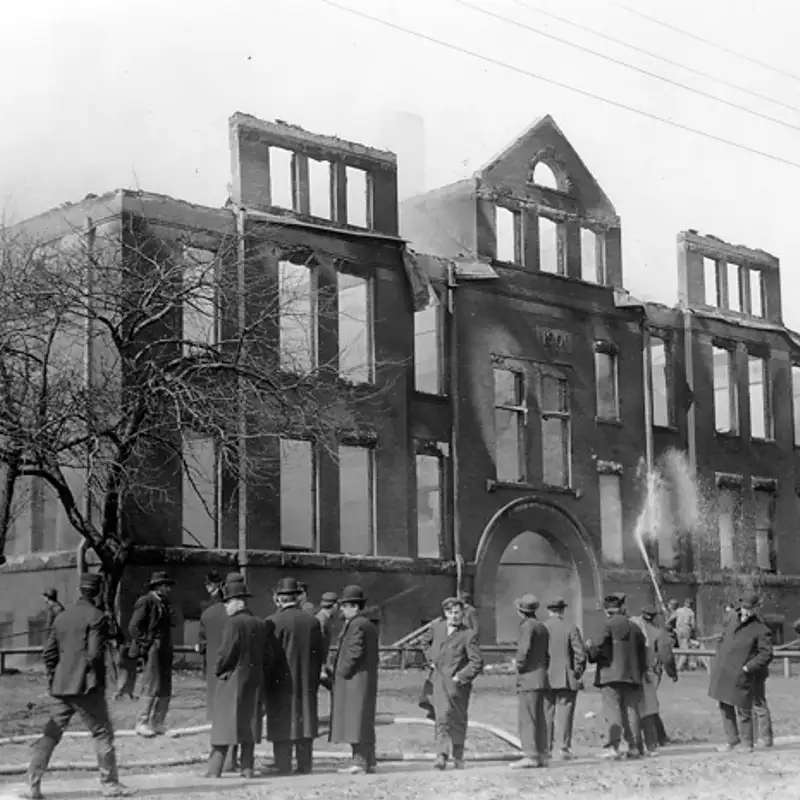
Lake View School, Collinwood Ohio, Part 3: A Village on Fire
As people from the village of Collinwood started to rush to the school in a desperate attempt to save the children, a bottleneck that was formed by an architectural decision made two years earlier was causing child upon child to fall just feet from safety. The intense smoke, heat, and flames pushed back rescuers with almost supernatural force. One hundred seventy three children and two adults would burn to death in a matter of minutes. In this episode, Tyler j Thomas, Jeff Moss, and I, Tim Coleman, will tell you what led to this nightmarish inferno. This is The Three Tumblers.
Jeff Moss:This is part three of the Lakeview School Fire. If you have not listened to parts one and two, please pause this episode, go back, and listen to them first.
Tyler J. Thomas:All attempts at accuracy have been made in producing this episode. Some details are lost to history forever, and what is written is sometimes contradictive. A list of source material will be provided in the show notes at our website, freetumblers.com.
Tim Coleman:This episode contains depictions of children dying. While we have left out the more graphic details, we felt that some were necessary to tell the stories of the victims and the lessons that had been learned from this tragedy. Now, the Lakeview School Fire part three, a village on fire. In the streets near the school, there were shouts and screams as the smell of smoke drifted through the air. People literally dropped what they were doing as others rushed by yelling at them that the school was burning.
Tim Coleman:24 year old John Leffel is near the school, and when he sees the smoke, he begins running as fast as he can to try and help save the children that were still trapped. The closer he gets to the building, the heat and smoke are so intense that his eyes burn and it's hard to breathe, but he keeps running to the building's rear entrance, hoping that it's not too late. I ran to the school when I saw the smoke. The rear entrance where the storm doors blocked up the arch was heaped with little bodies. I seized the first children I could reach and dragged them out.
Tim Coleman:Some of the children seemed half suffocated. Some were unconscious. I did not stop to look. I seized them by the arms or legs or bodies and tossed them out behind. Andrew Dorn and Wallace Upton both live and work in the neighborhood and also run to the school.
Tim Coleman:They each have children trapped inside and run to the back door as well. By the time the men are able to break free a stuck door, children are in a pile at the bottleneck of the bottom of the stairs. They are already starting to burn. Andrew finds his daughter, nine year old Gretchen, and tries desperately to pull her from the crush of children, dislocating both of her arms in the process, but still cannot free her. He is finally forced to let go as he himself is starting to burn.
Tim Coleman:Wallace manages to rescue 18 children by pulling them from the heat despite having second and third degree burns covering his arms. Only later does he learn that his own child was amongst the ones he managed to save. When it comes to children perishing in fires, I have a unique perspective to bring to this discussion. First, I would like to let our listeners know that neither Jeff nor Tyler has any prior knowledge of this story, so their reactions will be real and unrehearsed. It was around one or two in the morning on 09/26/2013 when I was working as a nine one one dispatcher.
Tim Coleman:I'd been on the job for just shy of ten years at the time. The center that I worked for was small and there were only two of us. My partner had only been working there for about a year and a half and had just recently gone from part time to full time and was assigned to work with me. He answered the 911 call before the first ring just like I trained him and within seconds of hearing his voice, I knew he had something that was not a normal call. Just as I started to click in to his line to monitor and assist, a second 911 call rang in, so I answered it.
Tim Coleman:Quickly, it was apparent to me that my partner and I were talking with two different people on the scene of the same house fire. The woman on the end of my line kept screaming that her babies were inside the house and that it was on fire. I dispatched the fire departments and EMS within forty seconds of my partner answering that first call. Between my partner and I and the information that we were getting, I knew that we had a two level house that was on fire and there were children trapped inside. At the same time I was dispatching the call on the radio, North Carolina State Highway Patrol trooper, Greg Gentoo, who was actually one of my instructors in the police academy, was on patrol in the area and he saw the light from the flames and the smoke, and so he decided to respond, especially once he heard my dispatch.
Tim Coleman:Trooper Gentoo got there within less than thirty seconds and also determined that there were children trapped in the fire, and he tried everything that he could to get in. And I'd like to say something about trooper Gentoo. He's a hell of a man. He's big, he's a force to be reckoned with, and he can run 10 miles and not run out of breath. I mean, he's just a a force of of a man.
Tim Coleman:So when trooper Gentoo was unable to get into the house to rescue the children who were trapped, that told me something. It told me that things were really bad. You know, firefighters and fire apparatus checked en route just within minutes of me giving out the call. And I had also alerted the fire marshals to respond as well that night. The house that burned was a two level ranch style house and the basement had been converted into its own full living space.
Tim Coleman:And there were two families sharing the same house. So one family lived upstairs, one lived downstairs. My partner had answered the call from the father of one family and I had answered the call from the mother of the second family. And despite the brave efforts of Trippa Gentu and responding firefighters and paramedics, an 11 year old boy and his six year old sister both died in the fire. They were upstairs in separate bedrooms.
Tim Coleman:One had an open door and the other had a closed door. The fire was later determined to have started in the living room upstairs and it was accidental in nature. Hearing the screams of a mother knowing that her children were inside of a burning house is something that I will never ever forget. And I can only imagine what it sounded like around the Lakeview school on the day of that fire. So many parents and people of the town witnessing that horror.
Tyler J. Thomas:What normally that when I was younger, I I don't think that would have hit me like it did now. As a father, now with a wife and a family, that's that hits, man. That's I can't even imagine that. I the the the scariest thing that's ever happened to us as a family is one of my middle child ran outside one day and was by the mailbox, by the street. No cars around, nothing like that, but it was like just that fifteen seconds of terror.
Tyler J. Thomas:Where is my son? What's going on? And we were my wife was crying, adrenaline rushing, all that. But he was okay. I can't even imagine knowing that something catastrophic is going on around you.
Tyler J. Thomas:You're helpless with that. Yeah. God, I can't I man, that's that's a that's a hard one, Tim. I think I appreciate you sharing that though. That man, that really sets it in.
Jeff Moss:Yeah. That's
Tim Coleman:awful.
Tyler J. Thomas:Just out of curiosity, the 11 year old and her brother that died, was it smoke inhalation? Was it were they ever able to determine how they died?
Tim Coleman:I I did talk with the fire marshal who investigated it, but he is retired now and he didn't have any of his files, so we couldn't really determine that. He couldn't remember and and neither could I. But most likely in structure fires when people die, it actually is from smoke inhalation and, you know, just the depletion of oxygen and asphyxiation.
Tyler J. Thomas:I think I think most people agree that the I guess the two possible worst ways to go are burning to death or drowning. And, I just hope it was as quick and painless as possible.
Tim Coleman:Previously, we mentioned that the school's fire alarm was basically just an internal alarm. There were no connections to the outside, including the Collinwood Village Fire Department. 11 year old Oscar Ponder was one of the fortunate ones to escape the school. Knowing that his friends inside the building are in mortal danger, he runs to the Collinwood Fire Department to notify them of the situation. However, there is no one at the volunteer station.
Tim Coleman:In fact, several of the members and horses used to pull the pumpers are miles away working on one of the village roads. To say that the Collinwood volunteer fire department resources were inadequate at the time would be an understatement. The department was small with only 20 volunteer members. Back then, just as it is today, volunteer firefighters had paying full time jobs and sometimes could not respond to fires. Also, the horses, which presumably were property of the village, were being used for road improvement.
Tim Coleman:There are precious few details on how members of the fire department were initially notified. However, later testimony described news of the fire quickly spread through the residents of the town, and people started rushing towards the school. The fire department's alarm, which alerted the volunteers to a fire, was rang at 09:45AM. Another full twenty minutes passed before firefighters arrived with their horse drawn wagon mounted pumpers. We could find very few details on the actual equipment that they had available, but based on equipment standards of the time, along with witness accounts, the gasoline powered pumps barely matched home pressure washers of today.
Tim Coleman:Also, in their haste, they forgot to grab an axe from the station, a mistake that would prove to be deadly. Once on the scene, the fire hoses leaked wildly and the ladders barely reached the 2nd Floor. Rescuers were within feet of the children, yet still completely out of reach.
Jeff Moss:So I have a good friend from high school who's been a long time volunteer firefighter. He's now the captain and fire marshal. So he's there all the time. This city only has a volunteer fire department. They're not truly volunteer.
Jeff Moss:They get paid when there's a call. But you are correct that they get dispatched from wherever they are. He carries a pager with them everywhere. If he gets a call and he's available, he goes. I have another friend who's a full time career firefighter, so it's a little bit different.
Jeff Moss:He has worked in volunteer type of agencies as well, but, you know, you know, you take anything that we do today and compare it to how they did it back then, look at our trade. You know, somebody locksmithing in the eighteen hundreds wouldn't have any idea what to do today. Firefighting, you know, the equipment was extremely rudimentary, but it's all they had. You know, they weren't equipped to handle a huge school building. Even probably with the biggest equipped departments and the most amount of people, it probably still wouldn't have really been able to do a lot.
Jeff Moss:You know, the city that I live in had a volunteer department for the longest time. I think they went fully full time in about 2000. They're not, you know, a volunteer department there. They may or may not be fully trained. You know, the equipment's not usually the newest and best.
Jeff Moss:And the response times are gonna be a lot longer than a twenty four seven staff station with fully trained, fully certified by the state firefighters with new vehicles, with constant education. Unfortunately, that's all they had. You know, Collinwood was not part of the city of Cleveland at that point, so it was a village with its own having to sort of sustain itself, I guess.
Tyler J. Thomas:Yeah. And researching this episode, I figured out or found out that 65% of firefighters in The United States are still volunteers. So granted, you know, they're a whole heck of a lot better than what we just heard, so I'm not trying to draw any parallels other than to say if if you're listening to this, you've only lived in areas that had a fire department that was paid. Most of this country still relies on volunteer firefighters. There are just under 700,000 volunteer firefighters in The United States right now.
Tyler J. Thomas:And I grew up in Atlanta my whole life, but I spent practically summer in Western North Carolina with my grandparents up around Murphy. And the two hour drive from Atlanta to Murphy, it's just, I mean, nonstop volunteer fire department buildings. It's almost like a, it was something we we looked at. We counted every time we went up. My grandparents were fortunate enough that their volunteer fire department was only about five miles away.
Tyler J. Thomas:I mean, that's insanely close for all intents and purposes, but especially in rural areas in The United States, it's not uncommon for them to be twenty, thirty minutes away. Yeah. I mean,
Tim Coleman:the volunteer department that I was in from my years as a teenager until early twenties, their budget was only $45,000 a year then. I mean, we're talking a long time ago now, but still everybody was completely volunteer. There were no, you know, pay per call like Jeff was saying. There was, you know, trucks that were twenty, thirty years old at the time, and they were put into service every single day. And everybody had to leave their jobs or get up and go run and grab a truck and then respond.
Tim Coleman:So, you know, the twenty minute response time for Collinwood, that's still a lot compared to today even with those departments like that. And also, as we talked about earlier in this series of episodes, the village directors were pretty much penny pincers. They were tightwads. They did not want to spend any extra money anywhere, and that's the exact same scenario that my hometown is going through right now. I mean, I just read the candidate profiles for the board of aldermen for that town, and they're all wanting more funding for the fire and police departments.
Tim Coleman:So it's something that a hundred fifteen years later, we're still dealing with. Something else that I want to mention is, you know, Oscar, the 11 year old boy who ran out of the school, he got burned. He was not unscathed completely. And he had the presence of mind not to just run outside and and fall to the ground in a panic or whatever. No.
Tim Coleman:He had the presence of mind to run to the fire department. Even though they weren't there, he knew where the fire department was and he knew that they could help his friends and his fellow students that were in that building. That is another young hero.
Tyler J. Thomas:Not for nothing and I was gonna ask this in the previous segment, but I guess I'll ask it now. Have either of you ever experienced any sort of serious burns? I I don't mean just like you you touch something hot, you got your finger burned or anything like that. Have have either of you experienced serious burns?
Jeff Moss:I mean, I got a second degree burn on my hand from a hot glue gun when I was about 12, but nothing other than that.
Tim Coleman:I've gotten a couple second degree burns that were like less than half a square inch total. So nothing major, but I've known people actually a well known, well experienced firefighting instructor was on a training fire and his hands had diesel fuel on them and got ignited and he got second and third degree burns on his hands. But personally, no, other than burning the end of my finger off with an electric cigarette lighter out of an old car one time and backing up too close to the propane infrared heater in our house.
Tyler J. Thomas:Well, you say that that reminds me of the guy at work, Scotty. I had that same experience that you just described. Heated as well. I guess it's a rite of passage for some children. I I've had third degree burns on on both my shoulders.
Tyler J. Thomas:My whole back shoulders, third degree burns to the point where I had to go to the hospital and had boils lanced off. And they don't give you anesthesia or anything like that. No, you had to take it raw. And I was about nine or 10 when that happened. And that, let me tell you, it's no fun getting burned.
Tyler J. Thomas:So I can't even imagine having the presence of mine, I was cowed over, ugh, in pain. I can't imagine running out to seek help, if anything. Then now, I would be laying on the grass just beside myself in the pain. And I've got scars still today from it. My wife's got third degree burn scars on her.
Tim Coleman:As rescuers are trying to pull children to safety, it quickly becomes apparent what has happened to trap them inside. The students had been trained in fire drills to only use one particular exit. During these drills, they lined up and followed their teacher's instructions. But on this day, when they started coughing on smoke and feeling the heat of the flames, panic took hold. They stopped listening to their teachers and started running down the stairs instead of the fire escape or windows.
Tim Coleman:The first children to reach the inner doors of both entrances were able to pass through the outside doors and escape quickly. But in the rush to get out, several children tripped or got knocked down and fell in the doorways and were trampled on by the kids behind them also trying to run for safety. The bottleneck point at the bottom of the stairs were small partitioning walls that had been constructed during the nineteen o six expansion in order to create more room for the increase of students to hang their heavy winter coats in. Those partitions reduced the width of the inner sets of doors at both entrances. According to testimony and drawings of the time, the partitions were about two feet wide, but they were directly in front of the bottom step.
Tim Coleman:The inner doorways were comprised of two doors that were both only about 28 inches wide. That's eight inches narrower than the typical front door on any house in The United States today.
Tyler J. Thomas:So two things here. Kids are wildly uncoordinated. I know that as a father now of three. Literally, as we were about to record this, and I'm writing my own commentary, we heard a loud thud upstairs, and my wife and I waited to hear if it was gonna be one of those crying falls or a no big deal fall. Kids trip and fall all the time.
Tyler J. Thomas:My oldest fell on the playground this week, and apparently it was one of those crying falls because the teacher texted my wife to let us know, you know, hey, he's gonna come home and tell you about it. So stairs, kids, not a good mix. But that said, and point number two, I trip going down the stairs a lot. Light flashing before my eyes, desperately grabbing for the handrail. I'm not immune to that.
Tyler J. Thomas:So I just don't like the layout of this school, especially for any elementary or middle school. The partition is, was the main culprit of loss of life here, no doubt. But even if it weren't, and considering how fast this fire spread, I am sure that there would still be at least some injuries just because of those stairs. Kids would have fallen, kids would have been trampled regardless, but I just don't like stairs being involved in an egress route for a building for kids.
Tim Coleman:Well, the convenience and style of the nineteen o six renovation, instead of expanding or taking away from other rooms, they took away from the stairwell and added these partitions just so that you could have basically a place to hang up coats and put the equivalent of backpacks. Know they didn't have backpacks then, but, you know, you have, like, your snow boots, you have, you know, whatever else kids took with them to school those days. And instead taking away from, say, the teacher's lounge or putting something more in the basement or, you know, throughout the classrooms upstairs, they narrowed the bottoms of these stairs just to accommodate that. And it was really just a matter of convenience and there was no style to it. It was just all practical building because it saved money.
Jeff Moss:Yeah. Like you said, these people are even today, they're pinching pennies, trying to build things cheaper, and eventually the shortcuts catch up.
Tim Coleman:And unfortunately, with the Lakeview School, when the kids got to that part, there as I discussed during the Iroquois series, the Observe, Orient, Decide, Act loop or OODA loop, their loops are already disrupted at that point. There's smoke, there's fire, there's screaming, there are kids running, there are kids falling in front of them, there are teachers falling behind them. And so when they get to the bottom of those steps and it's just a bottleneck, I can't even imagine what was going through their head other than I've got to get out of here. I'm gonna die. And as someone who was short and skinny as a kid, I'm still short as an adult, but, you know, being the runt of all the neighborhood kids, it was you get bumped into and knocked around all the time.
Tim Coleman:Yeah. You kinda grow out of it. You learn how to deal with it, but imagine being six years old. You know, my boss's grandkids are four and six years old, and they come to the shop all the time. And I look and I'm like, jeez, they they are just so small.
Tim Coleman:And I can't imagine hundreds of them running for their lives through a tiny little door that is narrower than the door on my front house. I mean, it's just ridiculous.
Tyler J. Thomas:Yeah. And even in the best of circumstances, trust me, even in the best of circumstances, kids don't listen or they can't have any sort of direction. So we yeah. We know that there were teachers there, and they saved, especially on the 1st Floor, a lot of students before the fire got too overwhelming in that one particular area, but adults panic. But we have maturity.
Tyler J. Thomas:We have wisdom. We have experience, not necessarily fires, but just dealing with adverse situations. And these kids have none of that. They've only been alive long enough to learn to walk, learn to read at that. So this is just it's not good.
Tim Coleman:And furthermore, like we were talking about last time, is that they're only trained to go one way out of the fire. And I think we're gonna talk about that a little bit more. But even even younger kids, I've noticed that and Tyler, you being a father, you can tell me better. But I've noticed that with younger kids, if you get them in a routine to follow one way, they will always follow that one way. So that's what they were doing on the day of this fire.
Tim Coleman:They were trying to follow the one way that they have been taught.
Tyler J. Thomas:Yep. You're exactly right because the best parenting lesson I ever got is get your kids on a routine. And when you disrupt the routine, they don't like it. You gotta go to bed every night at 09:00. You stay up past 10:30, they're waking up, or they're expecting it the next night.
Tyler J. Thomas:The fact that there's only one way out, you know, we've learned from that. Now we've got multiple routes out when we were in school, Jeff and I. But you've got to get them on a routine. And then when you disrupt that routine, they don't know how to function because they're only used to one thing. Now us as adults, we meet adversity.
Tyler J. Thomas:We can compensate, we can adjust to it. But we're 36, 37 years old, we've got all that years of experience and wisdom, but they don't. They don't know how to adjust to this. And I frankly, at 36, if I'm in a fire like this, I don't know if I could adjust to it.
Tim Coleman:With the most intense flames at the front main entrance to the building and the bottleneck at the rear doors, there was yet another obstacle preventing escape. On the top of the right side door was a chain pull bolt. Basically, this is a spring loaded bolt mounted to the top of the door that when engaged locks a steel bolt into a strike or hole in the door frame. To release the bolt, you pull a short chain attached to the bottom of the device and it retracts the bolt allowing the door to open. Mister Fritz Herder, the school's janitor and custodian, in a heroic effort makes his way to that door and releases the chain pull bolt allowing some children a chance at escape and rescue.
Tim Coleman:A telegraph message was sent to Cleveland saying, quote, send help. Collinwood School is burning. Cleveland fire chief Wallace receives the message and immediately dispatches engine company thirty as well as a truck company to the school under the command of battalion chief Fallon. Their first equipment to arrive on the scene was an engine, a hose cart, and an auxiliary truck. Although the Collinwood Fire Department members forgot to grab their axe from the station as well as their ladders being too short.
Tim Coleman:Cleveland firefighters had axes and taller ladders. Though the fire had progressed so quickly, they were all but useless. The 2nd Floor is burned so badly, it collapses down into the 1st Floor and then both fall to the basement in a bed of scorching flames and embers. Some of the Cleveland firefighters set up the ladders that could reach the 3rd Floor of the Lakeview School and actually managed to save several children. However, the yellow pine timbers that held up the fifth grade classrooms finally burned through so much that this floor falls to the basement, killing the remaining students that were trying to be rescued.
Jeff Moss:So this would be sort of like a front runner. You know, now they have pretty much automatic mutual something bad happens in your city, they they're already dispatching the next city. Before we went live, I was listening on my police scanner. There was an electrical fire at one of the synagogues, and as they were paging University Heights fire department, they were automatically having Beechwood show up. And then once that happens and they got there and it was a working fire, then they called more more of the other suburbs to come help.
Jeff Moss:You know, not having an axe with you would be like the equivalent of going to work without a screwdriver. You know, it's like the most basic tool of your profession. I can understand the ladder is not being long enough because it's a bigger build. Probably, it was probably the largest building that they had in that area, I'm guessing. Not that that's an excuse, but now they would just buy a buy the tallest ladder truck they can find.
Jeff Moss:It's scary and the help probably arrived kind of late. Even if they would have had the axe and the taller ladders when they got there, it it probably wouldn't have made a huge difference because these guys are responding from wherever they're at.
Tyler J. Thomas:Yeah. That's kinda what's really pissing me off as I'm hearing this is that minutes, maybe seconds away from rescue and the 3rd Floor collapses. So if the horses aren't being used elsewhere or any of these other failures don't happen that we just discussed, they should have been able to rescue everybody on that 3rd Floor that was still alive at this point. But they didn't.
Tim Coleman:Which is why I think that the woman who managed to go to the telegraph office and send the message to Cleveland for their fire department, she was another yet another hero out of this whole story. I mean, this whole thing with the 3rd Floor, that combines two of my greatest fears in life. My biggest fear is falling and like physically falling. And second biggest fear is getting trapped in a fire and being burned to death. Even though I've been in fires before with protective gear and oxygen, I would not want to be in a fire without it.
Tim Coleman:And also, on top of the right side door, the chain pole latch, that I mean, today,
Jeff Moss:you
Tim Coleman:would think that that would just be completely ridiculous for anybody to ever want. Yet, about four months ago, a customer of ours, it was a private school, they wanted to increase the security of their school and wanted me to install deadbolts not mounted at the regular height and location on the door, but mounted on doors, double doors to the gym, equipped with surface mount vertical rod exit devices. They wanted dead bolts mounted at the tops of those doors. And I looked at the maintenance man and I said, you cannot do that. And I said, even if you get the fire marshal to approve it, I will not install it.
Tim Coleman:You can find another locksmith to do that. And he's like, well, why? I said, you're six foot four. I said, you can easily reach that. You have teachers and students though who are shorter than I am at five seven, and they're not gonna be able to reach that to secure the building in the first place, and second, they're not going to be able to reach it to unsecure these doors emergency.
Tim Coleman:So no, you are completely trapping these students, these kids, these teachers inside of this gymnasium. You should not even be thinking about doing this. If you want a way to quickly secure the doors, we can sell you dogging keys that are designed to mount in the exit devices and remain there permanently so that in the event that you need to do a lockdown, all anyone has to do is turn those dogging devices and the push pads pop right out and your gym's secure. And his answer was, well, but there are so many keys to the gym. I said, then that's a completely separate problem.
Tim Coleman:I said, if you're worried about somebody who has keys to the gym coming through here shooting up students, you've got bigger problems than me telling you no about mounting deadbolts on the tops of these doors.
Jeff Moss:We get, you know, usually a little old lady who wants a one of those chain locks for the inside of the apartment door so that, you know, the maintenance guy can't get in and we don't sell them anymore. Go buy one at Home Depot if you're that. And they make it with a key as well which remember when I was a kid, my grandparents had the little chain thing but you just slide the thing out. It's easy but if you had to fumble for a key, you know, to get out of your only door, not a good idea. And you know we are frequently telling people things that they we've been having issues with some neighbors strip with ventilation and other things and the fire department came and cited them.
Jeff Moss:Like, they can shut your business down. So, you know, if there's something that you see out there or somebody's doing something, you know, yeah, you directly can't stop them, but there you can certainly report it to the proper authorities.
Tyler J. Thomas:You know, I remember within this last year, we had a bank, one of our bank customers out of state. We were using a subcontractor, and their quote solution was to install one of these chain bolts. And that's when I learned that they still exist and all of that. And they said, we're gonna put this on here. And I said, absolutely not.
Tyler J. Thomas:No. Never. We'll we'll find something else or they're just gonna have to deal with the circumstances. But, mean, if if you've never if you're listening, you've never heard of a chain bolt, basically what it is is if you can imagine links and links of chain, not like a, you know
Jeff Moss:The one I'm thinking of is just like a, you know, mount on the inside of the door with, like, four screws made by, like, National Hardware. They're brass.
Tyler J. Thomas:Right. And they have, like, a key ring. That's what's pulling it down. So number one, that doesn't meet ADA. But number two, you've got to be tall enough to grab it and pull down, which, like Tim's saying, you don't have to be six foot four.
Tyler J. Thomas:You don't even have to be five foot four. But if you're three feet four as a child, you can't get that.
Tim Coleman:I mean, we couldn't find the measurements on this door. I looked and and I think you look, Tyler, as well. So we don't know how tall these doors were, but you think if they're a a, you know, 83 inch door, that's still kind of a reach for somebody who's my height. I mean, you you kinda gotta step up. It's really funny watching me work on door closers on, you know, those sides of doors, but at the same time, you think that there are kids who are who are shorter than I am.
Tim Coleman:And back then, adults were shorter in general here in America. So, yeah, if you have one of those chain pulls, then you have to reach for it. You have to pull it. You have to know that it's there in the first place. As grieving parents arrived at the scene, firefighters and volunteers began pulling bodies from the rubble.
Tim Coleman:Local ambulances, such as they were at the time, transported victims that were still alive to doctors and hospitals. A makeshift morgue was set up in a railroad shop and held 162 bodies within the first five hours. Eight year old Glenn Barber had realized that he would not escape through the stairs and made the decision to jump from the second story. Although he was alive after jumping, he died from injuries due to the fall just three days later. Some of the bodies were so badly burned that identification had to be made from articles of clothing by the parents themselves.
Tim Coleman:The mother of Niles and Tommy Thompson could only identify the boys by their shoes. One account shared that a little girl was identified by her parents only after the family dog laid down and curled up beside her body. 21 bodies were burned beyond recognition and were never identified.
Tyler J. Thomas:Tim, just in your research, were the 21 bodies parents were available? In other words, they they they had children that were missing. And it was just they didn't know which were which, but they all had claims to them, so to speak. They they had parents that knew that they were their parents. They just didn't know which ones.
Tim Coleman:Yeah. The 21 unidentified bodies were just burned and mangled so badly from the fire and whatever rescue efforts may have taken place that there was just no visual recognition. My clothes were burned completely off. Hair was burned. About the only thing that they might have been able to determine would be gender.
Tim Coleman:I mean, when bodies get burned, they go through just this complete change. You see posturing, the the skin and hair is gone in a lot of places, and muscles contract. Bones actually tend to snap sometimes. And so what you see just is not anything that you could recognize. Today, we have dental records.
Tim Coleman:We have DNA testing. So we are much further along today in being able to identify the deceased from incidents like this. But back then, it was visual recognition. Pieces of clothing, hair, you know, did a mother braid her daughter's hair in a certain way? Did, you know, Tommy and Niles Thompson, their mother recognized their bodies by the shoes that were left on.
Tim Coleman:That was it.
Tyler J. Thomas:That, yeah, that that hits close to home because, God forbid, if if that were to ever happen to our family, my wife takes exceptional pride with how she dresses them and their shoes, and she knows exactly what their shoes are, and she gets upset when they get them dirty. But that is God, that is very sad because my wife, she could identify by that. That's so that God, that's
Tim Coleman:Even as the firefighters and heroes of the village of Collinwood were still pulling the small burned bodies of victims from the rubble, the investigation began. None of the people wanted anyone to suffer this type of horrible loss in the future, but all wanted justice for the young lives that had been lost.
Jeff Moss:Next time on The Three Tumblers.
Tyler J. Thomas:It's gotta be the pipes, the steam pipes.
Tim Coleman:That fire once started in the basement could go floor to floor to floor.
Jeff Moss:Perfect storm of bad construction.
Tim Coleman:Executive producer is Tyler j Thomas. Technical producer is Jeff Moss. Writer and editor is Tim Coleman. Find this episode and others along with source material at 3tumblers.com. This has been a Three Tumblers production.
Tim Coleman:Copyright 2023. All rights reserved.